


Introduction
After the success of the Nexon EV and Tiago EV, the Tata Altroz EV represents the next significant step in Tata Motors’ expansion of its electric vehicle line-up. The Altroz EV shares the ALFA architecture, rich in premium design, long-range capability, and modern electric mobility features. It is positioned as a more innovative, cleaner alternative for urban commuters seeking the practicality of a hatchback with the refinement of a premium EV. With fuel prices on the rise and growing demand for electric hatchbacks in India, the Altroz EV is expected to be vital in accelerating mass adoption of EVs.
Brief Overview of Tata Altroz EV
- Based on the ALFA modular platform, adapted for EV packaging and safety.
- Modern features: large touchscreen, digital cluster, connected-car features, fast charging.
- From the Altroz petrol but updated mechanically for the EV experience, with performance refinement.
Why This Launch Matters for India’s Electric Hatchback Segment
- Expands the currently limited premium electric hatchback options in India.
- Bridges the gap between Tiago EV (budget EV) and Nexon EV (SUV EV).
- Helps accelerate adoption in the fast-growing ₹10–15 lakh EV category.
- Sets a new benchmark for long-range EV hatchbacks designed for Indian driving conditions.
Positioning: Premium Feature EV
- Marketed as a high-end EV alternative for buyers desiring both style and practicality.
- It will offer EV performance, low running cost, and Tata’s strong safety reputation.
Launch Timeline & Availability
Tata Motors has confirmed the Altroz EV’s arrival in India for 2025, recent reports suggest the timeline may have slipped slightly, with some sources now expecting its introduction by 2026–2027. With these moving estimates, the exact launch timing remains somewhat speculative, but most in the industry expect it to begin ramping in the next 12-18 months.
Expected Launch Window, Target launch year: 2025
- If delayed, alternative timeframe: early 2026 or possibly 2027
- Uncertainties are due to the development, battery-pack packaging, and production readiness, all of which Tata is adjusting.

- Likely to be offered in multiple battery-pack options-e.g., similar to sibling EVs, perhaps around 25 kWh and 35 kWh options.
- Motor outputs could be different: base trim with a reduced output, around ~82 HP / 114 Nm; top trim with increased output: ~122 HP / 190 Nm. This would reflect differing use-cases: city versus long-range/performance.
- Configuration: likely front-wheel drive, single motor, as is familiar with most EV hatchbacks, and multiple trims based on battery and feature set.
Expected Cities for First-Phase Availability
- No confirmed list yet; however, given typical EV launch patterns in India will most likely be included in the first cities.
- Sales are likely to be focused first in urban and peri-urban markets where the electric vehicle infrastructure and demand are mature, particularly where the charging infrastructure is stronger.
- Since this rollout heavily depends on charging infrastructure and dealer readiness, it may be available initially in fewer states and expand incrementally.
Why Tata May Choose This Timeline:
- Rising fuel prices and increasing awareness are pushing many buyers toward EVs, making 2025-2026 a strategic window.
- Urban areas are seeing stronger adoption of fast-charging networks, a propitious environment for launching a new hatchback EV.
- Tata already has iCNG, petrol, diesel, and EV-ready architecture. Adding Altroz EV completes the whole portfolio from affordable to premium, ICE to electric.
- Competition & Market Gap: There is a gap between budget EVs and premium SUVs. Launching premium electric hatchbacks can tap users who want EV benefits without SUV size/prices.
- Readiness of the battery/packaging: Up until lately, technical hurdles-meaning battery packaging and platform adaptation-have delayed the EV launch, but once those are resolved, timing becomes propitious to launch within the next few years.
Exterior Design
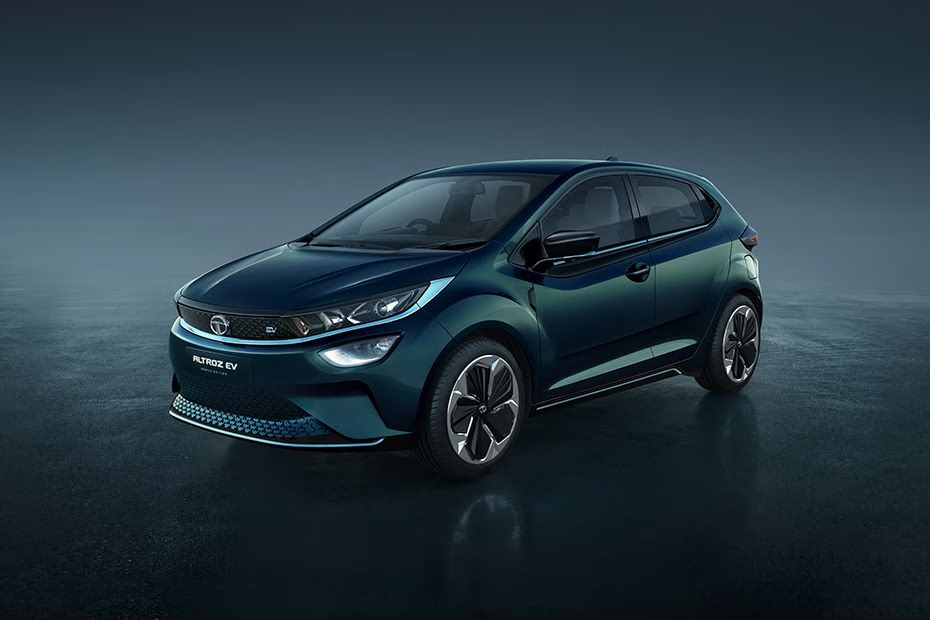
The Tata Altroz EV retains the premium, sporty stance of the standard Altroz while introducing a cleaner, more futuristic electric identity. Tata has refined the hatchback with sharper aerodynamic lines, a sleeker profile, and reduced drag elements to improve range efficiency. The closed-off front grille immediately sets it apart from the internal combustion-engined petrol/diesel variants. It imparts a modern EV look similar to that of Tata’s latest electric models. Overall, the Altroz EV strikes a good balance between familiar styling and EV-specific upgrades, making for a design that feels both urbane and efficient.
EV-Specific Design Elements
- Blue highlights around the grille, bumpers, and window lines to visually distinguish it from the ICE version.
- Blue-tinted badging and EV-specific highlights are integrated into the exterior lighting elements.
- Aerodynamic alloy wheels
Redesigned front bumper and LED DRLs
- Sleeker, more sculpted bumper with EV-friendly airflow optimization.
- Sharper LED DRLs inspired by Tata’s latest EV design language are seen on the Curvv and Punch EV.
Exclusive EV colour options
- New signature blue/teal shade expected to appear only in the EV model.
- Additional premium dual-tone options that accentuate the car’s futuristic styling.
Charging port placement and visibility
- The SAE combo would likely be in a front grille or side fender location for easy access during AC/DC charging.
- Convenience and modern aesthetic: clearly marked charging flap with EV branding.
Interior & Features
The cabin of the Tata Altroz EV is expected to receive a modern, tech-laden makeover to complement its electric powertrain. Maintaining the premium layout of the ICE Altroz, its EV version gets an even cleaner dash design, new EV-specific displays, and even better materials to take the in-cabin experience up a notch. The electric architecture also enables better space optimization, freeing the cabin of clutter. Sumptuous textures, ambient lighting, and a fair amount of features make the Altroz EV a refined in-cabin experience, apt for daily city drives and long ones.
Interior & Feature Highlights
- Larger touchscreen infotainment system
- Expected 10.25-inch high-resolution touchscreen.
- Upgraded UI optimized for the EV functions: range prediction, charging status, and energy flow.
Fully digital instrument cluster
- EV-specific graphics for battery SOC, charging speed, and regen modes.
- Crisp animations similar to the Punch EV/Nexon EV cluster.
Wireless CarPlay/Android Auto
- Seamless integration of smartphones without cables.
- Improved stability and quicker pairing thanks to updated software.
Connected car features: ZConnect-like suite
- Remote lock/unlock, geo-fencing, driving behaviour analytics.
- Battery status, charging alerts, and range estimation via smartphone.
- OTA (over-the-air) software updates for new features over time.
Auto climate control, ventilated seats
- Fully-automatic temperature control with EV-optimized cooling.
- Ventilated front seats are expected as a segment-first feature for summer comfort.
Premium sound system
- Improved audio tuning for a quieter EV cabin.
Battery, Motor & Range
The Tata Altroz EV is expected to be powered by Tata’s lithium-ion battery pack planned for long-term durability and high efficiency. It focuses heavily on real-world range and energy efficiency, so strong city mileage is expected from the Altroz EV while still allowing comfortable highway travel. With enhanced thermal management, improved electronics, and faster charging support, the Altroz EV aims to offer a proper, practical electric experience for everyday users.
Battery, Motor & Range
- 30–40 kWh battery pack (expected)
- Two battery sizes are likely, similar to the strategy used in Tiago EV and Punch EV.
- A larger pack suited for long-range users; a smaller pack for city commuters.
- IP67-rated battery protection, for water and dust resistance.
300–400 km real-world range
- 350–450 km ARAI-certified, depending on the variant.
- Optimized for city usage of 200–250 km, even with AC and mixed traffic.
- Improved efficiency because of the aerodynamic design and low-drag wheels.
Single-motor FWD layout
- A front-wheel drive motor is ideal for hatchback dynamics.
- Expected output: 80–120 HP, depending on the variant.
- Smoother torque delivery for quicker acceleration and quieter operation.
Regenerative braking levels
- Multilevel regeneration system- probably 3 to 4 levels, to improve recuperation by batteries.
- One-pedal driving is possible at higher regen settings.
- Drive modes: Eco, City, Sport
- Eco for maximum range.
- City for balanced daily driving.
- Sport for quicker acceleration and high responsiveness.
Fast charging capability: 0–80% in ~1 hour expected
- Compatible with 30–50 kW DC fast chargers.
- Expected AC home charging time with a wallbox is 6-8 hours.
- Improved thermal management allows the charging speed to be maintained even in hot climates.
Performance & Driving Experience
The Tata Altroz EV will deliver a refined, smooth in-car experience with its silent electric motor and seamless torque delivery. The absence of engine noise and vibrations, coupled with optimized suspension tuning, will be reassuring on both day-to-day office commutes and longer weekend drives. Though the vehicle is ideal for city use, its battery size and available power are sufficient for occasional highway driving as well. In all, the Altroz EV will be a balanced blend of performance, efficiency, and driving comfort, targeted at both first-time EV buyers and premium hatchback buyers.
Performance & Driving Experience
- 0–100 km/h expected under 11–12 seconds
- Quick, linear acceleration due to EV torque characteristics.
- Faster than most ICE hatchbacks in the segment.
Instant torque delivery
- Immediate throttle response, ideal for city overtakes and stop-go traffic.
- Strong mid-range pull for short highway bursts.
Low running cost vs petrol Altroz
- Cost per km expected to be under ₹1–1.2 with home charging.
- Minimal maintenance: no oil changes, fewer moving parts.
Improved suspension tuning
- Balanced suspension by placing batteries for weight.
- Stability improved at higher speeds, along with less body roll.
Improved NVH – EV platform updates
- Quieter cabin due to reduced vibrations and zero engine noise.
- Additional insulation is expected around the floor and motor housing.
Safety & Build Quality
The Tata Altroz EV is expected to continue Tata Motors’ strong legacy of delivering some of the safest cars in India. Built on the already proven ALFA architecture that earned the ICE Altroz a 5-star rating from Global NCAP, the EV will likely inherit the same robust structural integrity. Further, with added reinforcements in the battery pack and enhanced stability controls, Tata aims to ensure class-leading protection for passengers with the Altroz EV, while also ensuring high build quality, durability, and long-term reliability.
Safety & Build Quality
- 6 airbags
- Expected as standard or on higher variants.
ABS + EBD + ESC
- Ensures controlled braking in emergencies.
- ESC adds stability on sharp turns and slippery surfaces.
Rear parking camera + sensors
- High-resolution rearview camera with dynamic guidelines.
- Front and rear sensors for better maneuverability in tight spaces.
Charging Options & Infrastructure
For convenience and economy, the Tata Altroz EV offers flexible charging options tailored for home users and frequent travellers. Home charging overnight charging being possible using either a standard 15A socket or a faster wallbox charger.
Charging Options & Infrastructure
- 15A home charging
- Standard household socket compatible.
- For slow overnight charging, ideal.
- Adds approximately 8–10 km of range per hour.
Compatibility with 7kW AC fast chargers
- Available at malls, workplaces, and gated societies.
- Provides quicker top-ups during work hours or when running errands.
Charging cost per km against petrol
- Home charging cost: approx. ₹0.9–₹1.2 per km.
- Cost of DC fast charging: around ₹2.5–₹3.5 per km.
- The Petrol Altroz costs ₹7–₹9+ per km.
Expected Price & Variants
The Tata Altroz EV is expected to sit between the Tata Tiago EV. It aims to attract buyers seeking a premium hatchback experience with strong EV of larger electric SUVs. Going by various estimates and leaks, the Altroz EV is expected to sit above the ₹7.99-₹11 lakh range.
Expected price: ₹10–14 lakh
- Early estimates put the Altroz EV at around ₹10 lakh at the base level, going up to around ₹14 lakh for higher trims.
- In fact, some estimates peg the price of fully loaded versions at up to ₹15 lakh.
Pricing logic: battery size + premium features
- Lower trim: smaller battery, targeting city-centric range and affordability.
- Mid/top trims: larger battery packs, longer ranges of 300+ km, advanced features like larger infotainment and premium interior add-ons.
- Additional costs depending on Tata’s bundled connected-car tech and optional comfort feature.
Tiago EV for budget city buyers
- Altroz EV for premium hatch customers who desire more range and features.
- Nexon EV for SUV-style buyers needing bigger interiors and higher power.
Rivals & Market Positioning
The Tata Altroz EV enters a segment that is gaining popularity with growing urban adoption of EVs the Altroz EV is compact SUVs, offering space, safety, and long-range capability.
Tata Tiago EV
- Cheaper, smaller battery, but Altroz EV likely to offer more space, range, and premium finish.
- Ultra-compact city EV; great for urban use but limited in space, practicality, and safety compared to the Altroz EV.
- Larger hatchback, decent range, but lacks fast-charging speed, features, and safety confidence.
Buying Guide: Who Should Buy Altroz EV?
- Daily commuters covering 30–60 km per day, ideal for office or city travel.
- Buyers seeking a premium hatchback feel, wanting to shift to the benefits of an EV: low maintenance, smooth ride, and modern features.
- City users who sometimes do highway travelling: a good balance of urban practicality and occasional long-distance range.
- People were focused on low running costs — electricity per km is much cheaper than petrol/diesel, and maintenance requirements are lower.
- First-time EV buyers looking for a safe, solidly built, long-range option without going for a bulky SUV, a hatchback that offers confidence, everyday usability, and modern EV convenience.
Conclusion
The Tata Altroz EV is expected to redefine the premium electric hatchback segment in India. With its well-rounded mix of long-range capability, stylish, and modern technology, it will surely appeal to both in-city commuters and occasional highway crossers alike. Situated between the Tiago EV and the Nexon EV, it blends practicality with a premium feel, making it a strong contender for India’s most practical and desirable EV in 2025. Buyers looking for a safe, efficient, feature-loaded hatchback will find an unbeatable package in the Altroz EV that might set new benchmarks in its class.
FAQs
When is the Tata Altroz EV expected to be launched?
The Tata Altroz EV is expected to hit the market by 2025, though early 2026 is also possible if there are minor delays. Nevertheless, the company has not confirmed any exact month for the car’s launch.
Will the Tata Altroz EV support fast charging?
Yes, the Altroz EV should support DC fast charging to 80% in about an hour, with options for AC home and wallbox charging.
What will be the expected price of the Tata Altroz EV in India?
The expected ex-showroom price is ₹10–14 lakh, depending on the variant and battery size. Positioning-wise, it stands above the Tiago EV but below the Nexon EV.
Is the Altroz EV good for long drives?
Yes, with a range of 300–400 km, regenerative braking, and a comfortable cabin, the Altroz EV is suitable both for city commutes and the occasional highway drive. With longer drives, it is best to plan the charging infrastructure.