


Introduction
Electric cars are seeing rapid adoption driven by advances in battery technology, increased manufacturing scale, and greater affordability. By 2025, EVs will no longer be a niche product and more economical alternative to traditional petrol and diesel cars.
Why budget EVs matter:
- Electricity is considerably cheaper than fuel, minimizing daily travel expenses.
- Smooth acceleration, silent operation, and compact dimensions make budget EVs perfect for urban traffic and short-distance travel.
What is a budget EV:
- Placed in the entry-level without sacrificing basic usability.
- Should offer must-have new features like regenerative braking and basic safety without inflating costs.
Selection Criteria
The first step is to reflect real-world needs: affordability, daily usability, convenience, and long-term ownership comfort. The “selection criteria” below help ensure the selected cars truly offer value rather than just low price tags.
Price range:
- Includes EVs whose sticker price falls within the lower or lower-mid segment, which could be affordable for the average person, first-time car buyers, or small families without premium-car budgets.
- You can focus on cars that can deliver acceptable features and usability at that price, avoiding “cheap but impractical” models.
- Emphasize overall cost of ownership, not just the sticker price: consider state subsidies and incentives, if any, and savings on fuel/maintenance costs over time.
- Prioritize models that balance cost and quality, not at the bare minimum but “value-packed”: feature-rich enough for daily use (AC, safety, basic comforts) while remaining economically accessible.
Realistic driving range for daily commutes:
- The range should be adequate for everyday urban or suburban use over a week, or several days’ driving, without the need for frequent recharging.
- Account for real driving conditions, not just ideal “laboratory” range figures, like traffic, AC use, and stop-and-go driving.
- Provide buffer: range should be higher than the average day’s needs to avoid “range anxiety,” particularly for users who may not charge every day.
- The key is to achieve balance, not necessarily a long-range electric cars, but an adequate range to make an EV practical and carefree for everyday commutes and running errands.
- Compatibility with home charging setups: Most budget-EV buyers rely on overnight charging at home rather than frequent public chargers.
- Reasonable charging time or availability of fast charging, if supported, to make longer trips or quick top-ups viable when needed.
- Ease of access to charging infrastructure locally, or a realistic assumption that the buyer can install a home charger, so owning an electric vehicle doesn’t become inconvenient due to a lack of charging options.
- Flexibility: can charge at home, while at work, or using public chargers for freedom and convenience without dependence on any one type of charger.
Practicality: size, comfort, boot space, usability:
- Suitable size for city driving: compact or subcompact form for ease of parking and maneuverability in heavy traffic.
- Interior comfort and usability: enough space for seats, ergonomic design, and good visibility, sufficient for everyday commuting, infrequent family use, or trips to the grocery store.
- Boot/storage space is enough for typical urban needs, such as shopping, luggage, small trips, without being at a luxury level.
- Usability overall: ease of use for the driver and passengers; sufficient ground clearance if needed, suspension for city roads, and comfort in general for daily driving, not just “bare-bones mobility.”
Brand reliability and after-sales support:
- Track record of the manufacturer in EVs or conventional cars: reliability, build quality, durability over months/years.
- Availability of service centers, spare parts, and the skill to handle EV-specific maintenance- especially in local/regional markets.
- Warranty and battery warranty terms are essential in EV ownership to ensure long-term protection.
- Resale value potential and overall support: since budget EV buyers may want to resell or upgrade later, a brand with a good reputation helps retain long-term value.
Top 10 Budget-Friendly Electric Cars (2025)
Budget EVs in 2025 stand in the middle ground between affordability and practicality, bringing improved technology. The following are the top 10 choices that offer good value for everyday users, especially city commuters.
The Tata Tiago EV remains the most affordable mainstream electric car in India, targeting first-time EV buyers and city commuters seeking a dependable, economical daily driver.
- Most Affordable Mainstream EV in India: The car’s entry price is wallet-friendly, making EV ownership more accessible to a larger audience.
- Ideal for city use: compact dimensions, smooth accelerations, and easy maneuverability through routes full of traffic.
- Offers a variety of battery options: Buyers can select either shorter- or longer-range packs based on daily driving needs.
- Low running cost: Electricity expenses and maintenance costs are much lower than those of petrol/diesel cars.
A futuristic micro-EV explicitly designed for narrow city streets and congestion-oriented urban commute patterns.
- Micro-EV is designed for tight city spaces: Ultra-compact size ensures effortless parking and navigation through congested areas.
- Futuristic cabin with big-screen layout: Dual-screen setup-infontertainment and digital cluster-provides a modern, premium feel despite being low cost.
- Very low ownership costs: cheaper to buy, run, and maintain than regular hatchbacks.
- Perfect for short commutes: Ideal for 20–40 km of daily travel, it’s excellent for office-goers and urban dwellers.
3 Citroën ë-C3
A practical, spacious hatchback EV that appeals to families or users needing more cabin room.
- Hatchback EV with spacious interior: high seating position, wide cabin, and good front/rear room at this price point.
- Good range for its price, offering a practical everyday range suitable for weekly commuting without frequent charging.
- Family-friendly: More space, comfort, and boot usability than all but a few entry-level standard micro-EVs
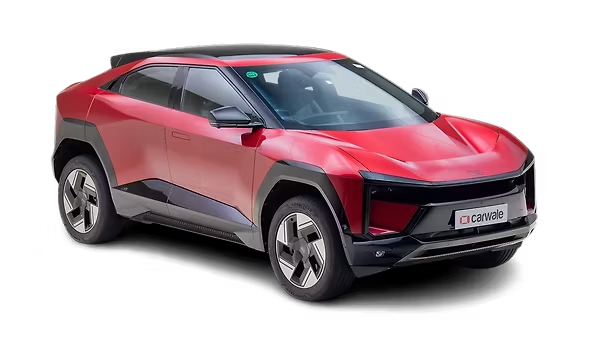
A compact SUV-styled electric car blending affordability with practical SUV-like traits.
- EV in a budget bracket, compact SUV style: It offers the stance and toughness of an SUV but without the high price tag.
- Higher ground clearance, better practicality: Suited for Indian road conditions, speed breakers, and the occasional rough patch.
- Suitable for mixed usage in the city and on highways: stable in town and gives confidence for weekend trips.
5 Mahindra eKUV100
Entry-level electric SUV in a minimalist design for simple, uncomplicated commuter needs.
- Compact electric SUV at an entry-level price: One of the most affordable SUV-shaped EV options available.
- Lean, simple EV for daily commuting: Minimum complexity, ease of operation, and practicality for local urban trips.
6 Nissan Leaf – Global Budget EV Option
Long considered one of the most accessible EVs in the world, it has popularity in many international markets.
- One of the most affordable electric vehicles in the world: Globally renowned for delivering robust electric vehicle performance at an accessible price.
- Proven reliability, comfortable ride: A decade-long legacy of dependable performance, good build quality, and smooth driving experience.
- Suitable for short to mid-distance, city-dominated travel: Ideal for daily use, errands, and typical urban commuting requirements.
7 Fiat 500e
A stylish European compact EV with high design appeal and urban practicality.
- Stylish compact city EV: Retro-modern design attracts lifestyle buyers seeking something different.
- Small footprint, ease of maneuverability in urban areas: ideal for narrow streets, tight parking, and generally dense urban areas.
8 Mini Cooper Electric-Base Model
Provides a high-end feel at a lower overall price for the Mini brand.
- The entry-level variant offers a premium feel at a lower price, making it a more attainable option for those seeking a premium badge in EV form.
- Great for urban lifestyle buyers due to the fun-to-drive nature, iconic design, and compactness.
9 Hyundai Kona Electric (Base Variant)
A worldwide favourite that dispatches practicality, a strong range, and SUV-like comfort.
- Compact SUV feel: Provides the comfort of an SUV in a smaller, more affordable form factor.
- Balanced value: range, features, practicality: Offers long usable range, modern tech, and everyday convenience ― a complete package for budget-conscious EV enthusiasts.
10 Ultra-Budget Micro EVs (Category Slot)
Represents the new breed of ultra-small two-door or micro-hatch EVs coming to the market.
Examples include entry-level microcars or the latest small EV models. These are newly emerging micro EVs designed strictly for city travel.
- Extremely affordable: One of the most economically friendly electric mobility solutions.
- Designed for ultra-short city travel only: Best suited for 10–20 km daily usage or drives within the inner city.
- Suitable as a second car or for short errands: Ideal for grocery runs, school drops, or hyperlocal commutes without fuel expenses.
Strengths of Budget EVs
Budget electric vehicles boast some of the strongest value propositions in today’s automotive market. For everyday users, especially city commuters, they offer a mix of affordability, convenience, and long-term savings that their more conventional petrol- or diesel-powered brethren cannot match.
Very low running cost compared to petrol/diesel:
- That means electricity is much cheaper per kilometer, lowering monthly commute expenses.
- With energy prices rising, EVs will continue to deliver significant savings over fuel-powered cars. Over the years, this has resulted in substantial cost savings.
Easy maintenance because of fewer moving parts:
- EVs do not need replacements or complex engine servicing.
- Its simpler drivetrain translates to fewer breakdowns and lower workshop bills. Brake wear is reduced, too, thanks to regenerative braking.
Ideal for city traffic:
- Instant torque means smooth, quick acceleration in stop-and-go driving.
- Most EVs in the budget category are compact, making them easy to park and navigate through congested traffic.
- Their quiet, vibration-free drive enhances comfort during commutes.
Increasing availability :
- Most budget EV users rely on home overnight charging, which makes the convenience factor high.
- Workplaces, malls, and public chargers are also expanding, allowing top-ups without much planning or long detours.
- Government incentives reduce upfront costs: Many regions offer subsidies, reduced registration fees, or tax benefits to EV buyers, significantly offsetting the initial purchase price.
- This has made the budget EV even more affordable for entry-level purchasers.
Limitations of Budget EVs
While budget electric vehicles offer substantial value and practicality, they also come with certain limitations that buyers should consider before making a purchase. Generally, those limitations stem from cost-cutting measures aimed at keeping prices low, affecting features such as range, size, charging convenience, and overall versatility.
Lower range compared to premium EVs:
- Most budget EVs feature multiple miniature battery packs to keep prices affordable.
- This naturally leads to shorter driving ranges, requiring more frequent charging for those users whose daily travel needs are longer.
- The range can go down further if AC/heater usage is high or driving conditions are demanding.
Smaller size or fewer premium features:
- Most budget EVs are compact hatchbacks or microcars, providing minimal cabin and boot space.
- To keep costs low, these models often scale back on premium features such as advanced driver aids, high-end infotainment systems, or luxury interior materials.
- These vehicles are centered around the basics rather than upscale comforts.
Less ideal for long intercity journeys:
- Budget EVs are not ideal for regular highway or intercity drives, given the shorter range and fewer fast-charging capabilities.
- The charging breaks may be longer, and the need for route planning concerning charger availability increases, especially in developing areas.
Availability of fast-charging differs by region:
- While some budget EVs support fast charging, the availability of DC fast chargers can be spotty across cities and states, limiting the ability to quickly top up the battery when needed and reducing convenience on longer routes.
- Some micro EVs may compromise on space or performance. Ultra-compact microcars prioritize affordability and city-level practicality; they often have limited boot space, lower acceleration, and modest top speeds.
- These limitations make them suitable only for short city commutes rather than versatile all-purpose use.
Who Should Buy Budget EVs?
Budget electric vehicles cater to buyers with a strong emphasis on affordability, practicality, and low running costs. These EVs are suited for everyday mobility but not for long-distance or luxury use, making them ideal for a wide range of urban users.
First-time EV buyers:
- Budget EVs provide the entry point to EV mobility, with low upfront costs and simple controls.
- These enable new users to get accustomed to EV driving, charging habits, and periodic maintenance without overwhelming complexity or expenses.
Daily city commuters:
- The EVs have compact dimensions, smooth acceleration, and efficient energy use, allowing them to navigate heavy traffic and short city runs.
- Their low operating costs make them ideal for users who travel 20–80 km per day.
Students, young professionals, and small families:
- At an affordable cost, budget EVs offer practicality and ease of use, making them well-suited for students and working professionals.
- Small families also benefit from the space, safety, and convenience offered by hatchback and compact SUV EVs.
Users seeking to cut fuel expenses:
- Compared to petrol/diesel, switching to electric can drastically reduce monthly commuting costs. Budget EVs maximize these savings and minimize the upfront purchase burden.
Those who need a compact second car:
- Ideal as an additional household vehicle for grocery runs, school drops, or local errands. Their tiny turning radius, silent drive, and low cost make them highly convenient for everyday usage.
Conclusion
Budget EVs today have become practical, reliable, and highly cost-effective mobility options for the everyday Indian user.
The Top 10 list reveals a well-rounded mix of EVs focused on city driving, compact electric SUVs, and globally popular, affordable models, giving buyers multiple choices based on their needs and lifestyle.
Range requirements, driving pattern, charging access, and overall budget should be analyzed before buyers make their final pick to ensure the best long-term value.
With India’s charging infrastructure expanding at a fast clip, 2025 is shaping up to be one of the best years to transition to an affordable electric car and make electric mobility more accessible than ever.
FAQs
- What would be the most affordable EV to purchase in India in 2025?
Based on your needs, options such as the Tata Tiago EV, the MG Comet, and the Citroën eC3 are considered to offer good value for money for everyday city use.
- What is the price range of affordable electric cars in India?
Most budget EVs fall within the ₹7 lakh–₹15 lakh range, depending on battery size, features, and brand.
- Can Budget EVs Be Used for Long-Distance Driving?
Budget EVs are great for city driving. Some will manage short highway trips, but long intercity travel may require careful charging planning.
- What is the general range of budget electric cars?
Most budget EVs have offered a real-world range of 120-260 km, depending on battery capacity and driving conditions.
- Do budget EVs support fast charging?
Many EVs around the entry-level mark now support DC fast charging, though the speeds can vary quite a bit. Others may be city-focused, supporting only AC slow charging.
- Are electric cars cheaper to maintain than petrol cars?
Yes, EVs have fewer moving parts and mostly require less maintenance than traditional petrol/diesel vehicles, including no oil changes.
- What are the government incentives for affordable EVs?
These include road tax exemptions, registration discounts, and subsidies, among others, that vary from state to state.
- How long do EV batteries last?
Most EV batteries are designed to last 8 Years, with manufacturers offering warranties up to 8 years / 1.6 lakh km.
- Is it safe to charge an EV at home?
Yes. It’s safe and convenient to charge at home with a certified wallbox or portable charger.
- Are budget EVs suitable for first-time buyers?
Of course, budget EVs are great for new EV users: easy to maintain, with low running costs, and smooth to drive in cities.