


Introduction
Tata Motors has never considered electric mobility a trend—it has treated it as a shift in the living itself of the future. With the series of innovations in Gen-3 EV architecture design and the human-centric interior design philosophy in the automotive world of the future, it takes a signpost towards the future in which the world will witness quieter vehicles, more innovative designs of the automotive world in the future, cleaner vehicles as the world progresses towards a green future with electric mobility in India in the upcoming years.
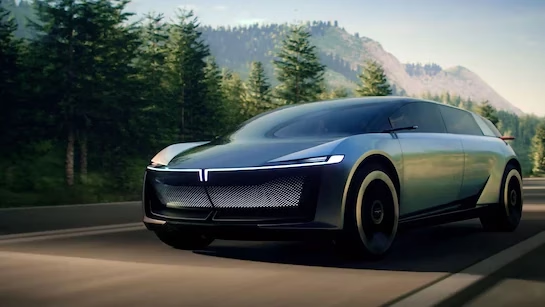
Around this signpost lies the Tata Avinya—a concept car which will be more of a proclamation of the world of electric mobility itself in the future. However, this proclamation of the world of electric mobility as the future of automotive innovation in India could take a bigger leap in the years to come, as it explores the possibility of a separate brand, Avinya, as a luxury electric vehicle brand.
Future Mobility narrative + Tata’s vision + Avinya brand development:
- Tata’s Future Mobility Ethos
- Considers EVs as an ecosystem phenomenon, not as products.
- Emphasis upon 3 Pillars: Sustainability, Software Intelligence, Human Space Design.
- Objective: to move away from car-centered mechanics to software-defined electric vehicles.
- Involves investing in skateboard chassis to promote flexibility and efficiency.
- Focus on the provision of emotional value – “EVs that feel premium, intuitive, calm, and personal.”
Avinya and the significance of more than just a car
- Its name means “Innovation” in Sanskrit. This emphasizes its ties to philosophy.
- Blurring the boundaries of home, office, and travel—imagine a mobile lounge, not a commute box.
- Uses sustainable materials that are not based on leather, and instead utilize recycled and biologically based materials in
- “Cabin experience over and above the dashboard experience” will be ensured by keeping the number of screens to a minimum.
- Integrated architecture for future autonomy, an artificial intelligence assistant, and sensor-based personalization.
- En Captures Tata’s Effort to Build an Electric Lifestyle Brand.
Development update: spin-off of potential brands
- Tata is also considering introducing Avinya as an EV-native premium brand.
- Goal: to rival international upscale electric vehicle sub-brands without undermining Tata Motors’ mass market electric vehicle brand positioning.
- Can introduce new concepts to retail space: Experience Centers, Test Lounges, Digital First approach to Sales, Subscription Services.
- The segments Brand can target are: premium hatchbacks, crossover MPVs, lifestyle SUVs, and luxury people movers.
- Strategy shift: From affordability-led EVs to aspirational EV lifestyle positioning.
- It is trying to bridge the price gap between Indian EVs and upmarket imported models.
- The device was likely manufactured in India to keep the price down. It would be Tata’s first venture into the future of multi-brand electric mobility, should it go through.
2. What is Tata Avinya?
The Tata Avinya was showcased at a global event in 2022 as a symbol of “Tata Motors’ Gen 3 pure EV architecture,” a “vision that showcased perhaps the most advanced thoughts of Tata Motors on electric mobility.” The Avinya was different from other conventional electric cars because it was launched in “born-electric” form. The concept of Avinya was developed by “engineering from a blank sheet of paper” to “celebrate a new age of Indian EV design,” characterized by “intelligent software solutions,” “wider interiors,” “sustainable material innovations,” and “future-proof platforms.”
However, “at a time when electric cars are becoming so ubiquitous,” along with its commitment to produce high-quality electric cars, “Tata Motors also believes in making them feel special, personal, and smart in a connected way,” so that they “are also in harmony with what is required in India.”


- Hardwired EV-specific foundation
- Developed explicitly for electric propulsion systems only (without compromise from ICE).
- Battery pack integrated into the floor, so low center of gravity = good stability.
- Facilitates flat floor cabin design. This increases the plane’s interior space and the versatility of seating arrangements.
Scalable & Modular Platform
- Can support a variety of bodies ranging from MPVs and Crossovers to lifestyle SUVs and future models.
- The wheelbase can be extended without affecting the overall design.
Why Tata Might Spin It Off as a Separate Brand
Avinya EV-native brands. This would give Tata a clean slate to compete with brands born in the electric era and built intrinsically around software, sustainability, and experiential ownership rather than legacy combustion engineering. Such a move would signal Tata’s ambition to evolve from an innovative Indian carmaker that makes EVs to become a future mobility architect with a distinct premium electric brand voice, one that resonates globally while being manufactured and priced intelligently for India.


- Freedom native to EV
- No restrictions in design, packaging, or engineering imposed by combustion layouts.
- Enables radical proportions, long wheelbase, short overhangs, and lounge cabin layouts.
- Brand messaging can shift from efficiency specs to lifestyle, emotion, intelligence, and serenity.
Aspirational positioning
- Creates a story over “affordable EV” → eco-luxury, future cool, digital sophistication.
- Helps attract young, upward-mobile buyers seeking a brand that is futuristic, not transitional.
Premium ownership model
- Personalized delivery experience, Relationship Managers dedicated.
- Higher service standards, including silent pickup/drop, doorstep diagnostics, and battery health reporting.
- Subscription maintenance plans and extended digital warranties could be possible in the future.
Digital-first sales and brand ecosystem
- Online configuration, transparent pricing, and home test drive booking.
- Seamless integration of the apps required for charging, vehicle health, navigation, entertainment, and security.
- OTA updates are marketed as a core brand promise, not an add-on.
Avoid dilution of Tata’s mass-market EV identity.
- The portfolio segmentation should be precise.
- Tata Motors EV = Practical, Accessible, Trusted, Mass Adoption
- Avinya Brand = aspirational, software-led, sustainable premium mobility
Brand equity protection
- The typical buyer of Tata’s electric cars today would look at three things: value, reliability, and low running cost.
- A premium sub-brand does not confuse the core audience or force a price-premium association on the Tata name.
- Avoids the risk of mainstream brand overstretch while keeping Tata as the parent innovation house.
Market strategy precision
- Let’s Avinya experiment with higher margins, new business models, and futuristic form factors.
- Tata Motors continues to dominate the volume EV revolution, while Avinya does so for image + future narrative.
4. India’s Premium EV Market Opportunity
The Indian EV market is growing rapidly, but the premium electric vehicle market is growing even faster. This is because a whole new set of buyers is emerging who are looking for the confidence of a bigger range, bright interiors, a distinctive design statement, and a digital ownership experience that should be as modern as their own lives.
The question in the market has suddenly shifted from “Can I afford it?” to “Is it future-ready?” The buyer is looking for a product with a high-range battery suited for highway driving, a comfortable driving solution through Artificial Intelligence, and a design language that symbolizes status without the need for any foreign badges. There is a whole market opening up in India for a truly Indian smart electric car like Avinya.
Market gap between affordable and imported luxury EVs
- Segment white space
- Mainstream EVs for the Indian market (compact and mid-size SUVs) will be positioned for value and use in urban settings.
- Luxury electric cars such as BMW, Mercedes, and Kia EV6 are imported or produced in limited volumes, involving premium price tags.
- This provides room for an indigenous developed, luxurious yet reasonably priced EV model.
Non-fulfilled demand
- Consumers want a “luxury car feel and functionality”: a high-quality interior and materials, a wide range of options, clever software features, and a smooth ride.
- The present mass-market EV offers no aspirational appeal, while imported luxury lacks affordability.
- “Opportunity for a new middle-premium tier with emotional appeal and high-tech differentiation.”
Rising willingness
- Young Indian consumers are now spending on tech, lifestyle, and mobility services.
- Currently, purchasing EVs does not only consider saving on fuel but also brand story, digital intelligence, and experience.
Local manufacturing = better pricing than global luxury imports
Cost advantage
- This is because localized manufacturing entails lower import duties, lower logistics costs, and lower exchange risks.
- Facilitates pricing that can be well below imported luxury EVs, while maintaining premium margins.
Battery and component ecosystem
- Tata has been investing in cell manufacturing, pack assembly, and thermal technology in India.
- “The local supply chain provides advantages in cost for larger battery size, thereby enhancing long-range positioning.”
Pricing potential
- A local premium electric vehicle brand could provide:
- Luxury imports “technology level.”
- However, for a price around that of upper mid-indian cars
- Offers a competitive advantage over international luxury brands that are also costlier in Indian markets.
Scalability
Local production is aided by:
- Faster variant expansion
- Increased manufacturing output
- Improved service and parts availability. Reduced the total cost of ownership (TCO) when compared to imports
5. What a Separate Avinya Brand Could Offer
Second, as a distinct brand, Avinya may help Tata envision what a superior mobility experience should look like in India—at first, lounge-like, stress-free interiors that value openness, silence, and comfort over conventional dashboard density. Inside, they could use eco-friendly, high-quality, non-leather, sustainable, recycled, and biotic materials, merging sustainable thinking with a sophisticated, contemporary notion of luxury. Rather than selling cars, Avinya may sell a life experience, in which software intelligence, autonomous readiness, carefully considered retail environments, and versatile product offerings all come together to form a new class of Indian EV ownership.
Bullets:
- AI assistant,
- OTA updates,
- Sensor-rich autonomy hardware
- Digital Assistant Based on AI Technology
- Voice-controlled interface that manages navigation, media, climate, seating, and vehicle functions.
- It learns the driver’s driving behavior and preferences.
- Provides multilingual capabilities (including Hindi, regional languages, and English).
Never-Ending Tasks Automation (NEWT)
- Feature updates without service center visits.
- The Software upgrades the car over time, offering innovations across various apps, efficiency, user interface enhancements, and enhanced safety.
- Brand promise could evolve to “always improving vehicle intelligence.”
Autonomy-ready sensor architecture
- Camera/Radar/Ultrasonic pre-fitted zones and future pre-fitted zones with LiDAR
- Centralized high-performance computing for real-time environment mapping and assisted driving functions.
- Allows for the evolution of ADAS from driver-assist to semi-autonomous systems across multiple product lifecycles.
Expansion of its product offerings in new EV forms of lifestyle
- Multiple Body Type Flexibility
- Crossovers, luxury MPVs, Lifestyle SUVs, and People Mover city cars all share the same skateboard platform.
- The wheelbase and battery layouts can be scaled up to accommodate larger passenger cabins.
Lifestyle-based segments
- “It’s designed for comfort, for traveling, for families, for professionals who work in the digital media space, for
Potential product tiers:
- Urban premium crossover
- Flat-floor MPV for families
- Lifestyle SUVs – Highway and Weekend Travel
Design-led personal mobility EVs
- Long-distance highway confidence
- More powerful battery packs are designed for Indian highways.
- Improved thermal efficiency and weight distribution that support long-distance trekking.
Retail shift to experience-driven buying
- Dealerships vs. Experience Centers
- The retail outlets have been conceptualized as technology lounges, lifestyle zones, and galleries for future mobility.
- Interactive exploration of products, such as AI cockpit simulations, interior layouts, and digital ecosystem tours.
Technology-driven purchasing journey
- Car configuration and booking through the App/website.
- “Appointment-driven test drive experiences crafted with comfort and exclusivity in mind.”
Premium Ownership Ecosystem
- Car delivery customized ceremonies.
- Dedicated support managers, silent pickup/drop services, battery analytics, and electronic health dashboards.
- Opportunities for subscription-based offerings, bundled apps, and extended warranties.
6. Key Challenges
The decision to make Avinya the new flagship electric vehicle brand is a bold move, but it also entails several complexities. Primarily, it has to build fast-charging infrastructure on highways and in urban areas to boost long-distance travel, encouraging new buyers to purchase the vehicle for its seamless experience. At the same time, developing such a new brand would require significant spending on research and development, including software, large batteries, and autonomy-based computing. For new entrants, the bills may be higher than those of established carmakers. Finally, the latest electric vehicle has to deliver the same quality and refinement as cars sold on the international market and cannot be held back by cost constraints.
Charging ecosystem scale, R&D cost, and global-level refinement
Charging Infrastructure Expansion
- They need quick, convenient, and reliable charging, not just occasional help.
- Needs more charging points of 150kW+ capacity, particularly on expressways and tourist routes such as Varanasi to Delhi, Mumbai to Pune
- The need to partner with hotels, malls, and office parks to provide reserved/priority charging points.
- Real-time charger availability has to be integrated with Avinya’s software layer for stress-free route planning.
Higher R&D and Software Development Cost
- AI assistants, autonomy compute, and the OTA platforms always maintain software teams, cloud infra, and data learning loops.
- The increased skateboard platform sizes require high-end battery technology, cooling solutions, and Safety engineers.
- “Autonomy hardware readiness implies sensor fusion capabilities and centralized computing, which drive increased cost and complexity.”
- Contrary to conventional car initiatives, EV-native, upscale R&D work costs money not once but infinitely.
Global-Level Granulation Requirements
Buyers compare top EV models with:
- Imported luxury car comfort
- Quiet acoustics
- “High Grade.”
- Interruption-free software user
Applicable
- Anti-vibration cabin engineering
- Enhanced suspension tuning suited to the Indian roads
- Premium tactile buttons, lights, sound, and insulation
- “Luxury-class service standards rather than mass market delivery.”
Marketing shift: value → aspirational buyer mindset
- Reframing Buyer Psychology
- Target audience for Tata EV: practical, value-for-money, fuel-saving mindset.
Avinya buyers must feel:
- Emotionally attracted, not economically pushed.
- Future-cool, premium status, digital lifestyle alignment
- Messaging will have to change from ‘Low running cost’ → ‘Intelligent, serene, sustainable premium mobility.’
Brand Story vs. Price Story
Price
- Needs to weave around:
- AI companionship
- Silent lounge cabins
- Eco-luxury
- Autonomy Evolution
Range Confidence of Explorers
Range
- The brand has to feel like it’s part of a movement, not just an upgrade to the variant.
- Ownership Experience Marketing
Highlight:
- Personalized deliveries
- Application-driven intelligence
- Remote Diagnostics
- Priority Charging Maps
Software Upgrades: A Sign Of Sophistication
- Instead, the buyer can think: “I don’t just own a car—I own a future platform.”
- Premium Trust Building Premium trust building
- Must convince buyers that:
- “Made in India” can also mean “World-class premium.”
- Avinya is no compromise on budget, but “a smart luxury car buying decision.” The brand needs high-impact campaigns, design storytelling, and influence presence.
7. Impact on Tata’s EV Lineup
Tata holds off Avinya as a distinct brand, and then Tata Motors’ EV strategy will shift to a two-lane approach. The existing lineup of EVs at Tata Motors, developed for affordability, durability, and usability, shall continue under the Tata Motors EV brand and drive mass adoption across both urban and highway use cases. At the same time, Avinya will emerge as a distinct flagship lifestyle EV brand, developed to delve deeper into innovations in software, space, sustainability, and product ownership. Such a strategy shall provide consumers with clarity of distinction, safeguarding Tata Motors’ established equity in EVs, and also liberate Avinya with a space in India’s fragmented premium EV category.
Current models are still in Tata Motors EV (Mass + Practical)
Portfolio Continuity & Segmentation
- Models such as Tiago EV, Punch EV, Nexon EV, Curvv EV, Harrier EV, and Sierra EV retained the Tata brand name.
- These models are value-priced, safety-assured, high-performing AC vehicles at an affordable price to run.
- Target consumers: Commuters, functional families, first-time electric-car buyers, budget travelers.
Market Role
- Tata Motors EV continues to be the biggest seller, driving the country’s electric revolution.
Continues focus on:
- Range-per-rupee value
- The scale of the service networks
- Battery life
- Cost-effective production
- Extensive dealership network
Ownership Promise
- Messaging remains grounded in:
- Trust, savings, safety, and usability
- Cars represent intelligent investment choices rather than indulgences.
Avinya – Premium Flagship Lifestyle Brands (Distinct Identity)
- Brand Re-Position
- Avinya – from “concept car” > a brand based on EV lifestyle emotion & software intelligence.
- Design DNA: The design DNA is futuristic, calm, spacious, sustainable, and software-driven
- Target Buyer = Tech Fanatics, Upscale Youths, Experience-Oriented Families, Design-Savvy
Product Differentiation
Focus on:
- Lounge-style, flat-floor cabins
- Artificial Intelligence-Driven
- Quiet, calm interiors
- High-range battery packs
- Software component
Sustainable Luxury Materials
- More lifestyle segments like:
- Premium Crossovers
- Family MPVs
- Lifestyle highway SUVs
- Urban personal mobility EV forms
- Retail & Service Ecosystem Shift
Move towards:
- Experience Centers, not mass Dealerships
- “Digital-first” buying & “OTA-first” feature delivery
- Premium service rituals: silent pickup or drop, relationship managers, and analytics dashboard.
Brand Identity Advantage
Enables Tata Motors to assert that:
- “Tata = EV for India’s revolution.”
- “Avinya = EV for India’s evolution.” Not a dilution in mainstream pricing identity, nor any confusion in buyer psychology.
8. Expected Timeline
Positioned by Tata Motors as the north star of its Gen-3 EV architecture, any transformation of Avinya into a separate brand would need the right moment, both strategically and technologically. The most logical window for a brand debut is after 2025, when Tata’s Gen-3 born-electric skateboard platform is expected to transition from a concept showcase to production-ready form.
This timeline gives Tata enough runway to mature its battery scalability, software stack, autonomy hardware zones, and premium cabin engineering, while aligning with India’s rapid expansion of charging infrastructure and rising appetite for lifestyle-driven EV brands. Though not announced by Tata, speculation is that Avinya may launch not just as a model but as a brand-defining product line, marking Tata’s entry into the premium electric identity space with a whole ecosystem rather than a single-vehicle rollout.
Expected timeline & rollout logic
- Platform Maturation Phase (2022–2025)
- Avinya was introduced as a concept in 2022, representing Gen-3 EV design and architecture DNA.
The 2022–25 period was about the validation of:
- Skateboard battery-in-floor integration
- Scalable motor and pack configurations
- The AI assistant backbone would be connected to the cloud.
- Autonomous sensor placement zones
- Sourcing materials sustainably
- No spin-off during this phase to avoid launching before the technological readiness.
Pre-Brand Readiness Phase (2025)
Expected internal evaluation of:
- Brand identity, pricing tier, retail strategy
- Software and autonomy partnerships
- Charging ecosystem collaborations
- Announced window – if Tata decides to make brand intent publicly known.
- The real-world road validation of the Gen-3 platform-based prototypes may begin in Indian conditions.
Speculative Brand Debut Window: 2026 onwards
Avinya could be launched as:
- A new independent premium EV brand
- Or a sub-brand under Tata’s EV umbrella, operationally separate
- The first product will serve as the brand’s manifesto product, not just another model.
Possible introductory parts:
- Lifestyle crossover
- Flat-floor premium MPV
- Top-of-the-line flagship SUV
- Local production is expected to begin in parallel, thereby supporting competitive pricing.
Retail & Ecosystem Launch-parallel to the First Vehicle
The brand could implement the following:
- Exclusive experience centres
- App-led buying and setup
- OTA-centric feature delivery
- Luxury service rituals
- Charging network partnerships are expected to scale before or alongside launch.
9. Conclusion
Avinya can be Tata Motors’ boldest strategic leap, one that is beyond launching a car and into launching a new identity for the Indian electric future. Separating Avinya from the mainstream Tata EV lineup could unleash the creative freedom to build a premium, software-defined, sustainability-led mobility brand, which speaks the language of the next decade.
This would let Tata be the leader in two worlds: the mass EV revolution with its existing portfolio and the premium EV evolution with an EV-native lifestyle brand. If executed at the right time with ecosystem readiness and storytelling precision, Avinya can prove that India does not just adopt the electric future but also defines it.
Take-home messages & lasting effect
- This deal signals Tata’s shift from being a practical EV maker to a future mobility architect.
- Could become Tata’s flagship answer to global premium EV disruptors.
Market Breakthrough for India
- Fills the gap between affordable EVs and expensive luxury imports.
- Offers Indian buyers a premium option without an import price penalty.
Brand Identity Benefits
- Tata EV trusted, safe, value-driven adoption.
- “Avinya is an aspirational, serene, intelligent, sustainable electric lifestyle.”
Domestic premium EV market
- Could be India’s first EV-native premium lifestyle automotive brand built at scale.
- Local manufacturing and software leadership may set a new benchmark for price and innovation in Indian EVs.
Cultural and emotional shift
- Moves India’s EV conversation from “kitna bachega?” → “Kitna aage badhega?”
- It could inspire a new era in which Indian mobility brands are globally admired, not just locally bought.
10. FAQs
Q1. Is Tata officially launching Avinya as a new brand?
Not officially. It is currently a concept line, but Tata is actively exploring turning Avinya into a separate premium EV-first brand.
Q2. Will Avinya cars be more expensive than Nexon/Punch/Tiago EVs?
Yes. Avinya is expected to sit above Tata’s current EV portfolio, targeting a premium lifestyle + future-tech segment rather than the mass market.
Q3. What platform will Avinya vehicles use?
They will be based on Tata’s Gen 3 born-electric skateboard architecture, which is designed for long range, flat-floor interiors, and autonomy-ready hardware.
Q4. Will Avinya be manufactured in India or imported?
Most likely manufactured in India, giving Tata a cost advantage to price it below imported luxury EV competitors while keeping a premium identity.
Q5. What features can we expect from the Avinya brand?
- AI-powered cabin experience
- Sustainable premium materials
- OTA software updates
- Lounge-style interior with flat floor
- Long-range battery options
- Autonomous-ready sensor suite
Q6. Will Avinya get fast charging support?
Yes. Since it will be a BEV architecture, fast charging compatibility will be a core requirement for the brand to succeed in the premium segment.
Q7. Which companies will be direct competitors of the Avinya brand in India?
Likely rivals include the Hyundai Ioniq series, BYD premium EVs, and imported luxury EV brands such as the BMW iX, Mercedes EQ range, and Kia EV6.
Q8. When can we see the first Avinya production car?
The expected timeline is post-2025, when Tata’s Gen 3 architecture fully matures into production models and the brand rollout.