Introduction
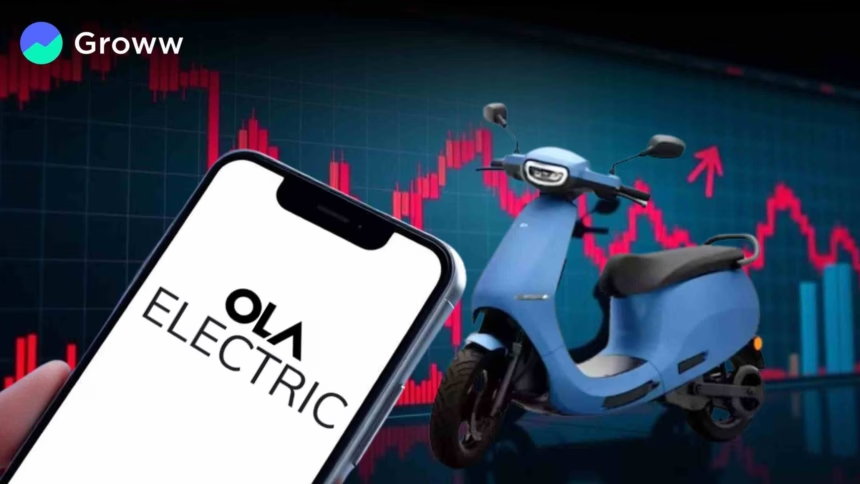
Ola Electric’s story since its IPO and listing on the stock markets has been nothing but a roller-coaster ride. The company completed an IPO in August 2024 and received significant market attention as India’s first pure-electric two-wheeler company to list on the stock exchanges. The stock made a debut performance at a price slightly above the issue price. The Ola Electric Shares began a sharp correction, reaching bottom levels, due to concerns about potential delivery delays, higher costs, and a loss of bottom-line amid balance-sheet pressures. The stock price became extremely volatile in its first year of trading on the market, driven by strong upside trend lines in response to business updates and a crash after quarterly earnings.
Ola Electric IPO & Market Entry
- Company listed: Ola Electric Mobility Ltd, the First Indian company to fully manufacture EV 2-wheelers.
- IPO year: 2024
- IPO size: ₹6,145 crore
Use of funds: The proposal
- Factory expansion and automation upgrades
- R&D of new two-wheelers and software
- Battery Cell Development & Ecosystem Investments
Charging network expansion (Hyperchargers)
- Market narrative after listing: Market volatility driven by growth versus profitability perspectives
Why Ola Electric Stock Is in Spotlight (2025-26)
Bigger Production Scale:
- Ola’s Futurefactory has an intended production capacity of 1 million+ vehicles every year.
- It also seeks cost leadership through high-volume production, automation, and robotics.
- Production ramp-up is viewed as an essential driver of margin expansion over the next few years.
Adding scooter & product offerings:
- The S1 Air, S1 X, S1 Pro, and S1 series are part of its prime lineup for electric vehicle buyers, ranging from budget to premium.
- Ola has publicly disclosed its lineup for motorbikes, which will see many models rolled out in production by 2025-26
- A diversified product portfolio can help tap new customer audiences and revenue opportunities.
Battery Road Map & Localization Push:
- Ola is also starting its own battery cell venture, “Bharat Cell” in India.
- “The long-term plan is to decrease our reliance on imported cells, driving our costs down and contributing towards our gross margins.”
- Advances in battery production are seen as a significant underlying catalyst for stock re-rating
Software Lock-in and Ecosystem Potential:
- It comes with features of connectivity, ride analytics with artificial intelligence integration, and over-the-air updates.
- Technology and software differentiation enhance customer loyalty and service, as well as software revenue.
- They also see this, in the long term, as high-margin revenue versus hardware.
Profitability debate and valuation interest:
- Ola is still incurring losses as it focuses on scale, discounts, and building an ecosystem.
- The progress on EBITDA enhancement and loss reduction is also strictly monitored by the
Market players are divided into:
- “Our vision is that local battery production in China, combined with their leading position in new energy vehicle technology.
Ola Electric Business Overview
The flagship products are a key component of the localization strategy aimed at reducing costs. At the core of the approach is the Futurefactory in Tamil Nadu. The MoveO connected software ecosystem and an expanding network of Hyperchargers to help overcome range anxiety and improve customer convenience. Each of these is integral to Ola’s comprehensive approach to gaining market share, developing long-term revenue streams, and reducing its dependence on key external suppliers.
 S1 Air: An entry-level variant for cost-cutters and city commuting.
- S1 X & S1 Pro: Mid-to-premium models that have better range, digital dashboard, and connected features
- Features strong performances relative to price: 0–40 km/h pickup and claimed ranges competitive in the segment.
- Emphasis on design and user experience with a tech-first dashboard and integrated apps
Upcoming Motorcycle Roadmap:
- Ola has announced plans to enter the electric motorcycle market to cater to customers seeking higher speeds and longer distances.
- Expected to have multiple variants to suit different customer segments: commuter, performance, and touring.
- Higher potential to capture a more wide-ranging market beyond scooters, while increasing revenue per unit.
- Motorcycle entry is considered a key future growth driver as 2W buyers change their preferences.
Battery Manufacturing & Bharat Cell Initiative:
- Ola’s Bharat Cell offers a robust set of plans to build domestic battery cell capacity in India.
- Focus on reducing dependence on imports, mainly from China & South Korea; secure the battery supply chain.
- Local cell production is expected to lower costs, improve margins, and support higher volume output.
- In tune with the government’s push for localized EV manufacturing and incentives given under PLI schemes.
Market Position, Sales & Production
EV 2W Market Position:
- Ola is one of the highest-volume electric scooter brands in India.
- Competes with Ather, TVS iQube, Bajaj Chetak, Hero Vida, and new entrants
IPO to Stock Performance
The journey of Ola Electric from IPO to market performance has, in fact, been nothing short of a roller-coaster ride. The initial weeks following the listing saw stocks touch new heights, even rising above double the IPO price for a brief period, marking an all-time high, further reinforced by massive brand presence and market domination. However, as 2025 progressed, the scenario changed. The stocks began to severely correct, even hitting new lows, amid concerns about slowing sales, rising expenses, and the prospect of a recession. The stock prices have been highly volatile throughout the first year since listing.
Retail vs institutional investor sentiment
Retail investors:
- High interest due to the EV growth story, future battery developments, and the brand’s mass-market appeal.
- Many retail investors consider the stock a long-term play, believing the marginal cost will improve once battery localization is scaled up.
- Increased participation in price dips, but also prompt exits on sharp declines, thus exacerbating volatility.
Institutional investors (cautious lean):
- Certain strategic shareholders reduced or unwound their stakes following the listing, indicating a lack of confidence in the execution process.
- It’s tracked more seriously by institutions than retail data regarding EBITDA, margins, and cash burn rates.
- Additionally, many funds are operating in a wait-and-watch mode, waiting for further indications on how much losses can be reduced before making big bets.
Fundamental Analysis
The stock is seen as in a growth stage, not a harvest stage. Its revenue growth pattern shows that customers have been increasingly accepting the company’s S1 series offerings, and the company can deliver better than it did in the initial years of its product launches. Yet, the company is in a highly sensitive state due to discounts, fixed scaling costs, and ecosystem investments.
Profitability Status
- Net loss is ongoing: The company continues to incur net losses because it focuses on size, costs, and ecosystems.
- EBITDA trend: EBITDA is improving as production volumes increase, but remains negative due to manufacturing overheads and operating costs.
Concerns about Cash Burn Rate & Balance Sheet
- Loss of Working
- High cash burn: Cash burn trends continue amid increased production capacity investments and other spending that exceed profits.
- Working capital pressures: They involve dispatch services that require inventory management, retail financing, and services.
- Debt and Execution Risks: The cyclical nature of significant capital expenditures raises concerns about leverage and the execution of future projects.
- Disparity between Valuation and earnings: Since the company has no earnings yet, the balance sheet must carry the company until margins improve.
R&D & Capex Focus
Battery cell investment (Bharat Cell)
- Localization of cells to reduce import dependency and enhance margins in the long run.
- Substantial investment is made in creating infrastructure, R&D, and pilot manufacturing.
Futurefactory expansion & automation:
- Designed for high-volume production in excess of 1 million units a year, necessitating incremental improvements in the production line automation.
- “Fixed manufacturing cost is high until the usage stabilizes at maximum levels.”
MoveOS software development
- OTA updates, connected functionality, and AI-based diagnosis demand ongoing investments in software development and the cloud.
- Software is an envisioned future revenue stream, but it is an expense today rather than revenue.
Retail & service network capex:
- Experience centers, service hubs, tech trainings, & spare supply chain are a part of capex.
Path to Breakeven Points – Substantial Issues
- Margin-led breakeven is feasible: it relies less on selling growth and more on improved gross margins, which are expected to increase as local battery production scales up.
- “Loss reduction trend key performance metric”: Investors are looking to see whether net loss is declining each quarter, which would indicate a trend toward profitable unit economics.
- Motorcycle market entry as a revenue enhancer: High-priced products such as EV motorcycles can improve ARPV and help reach the breakeven point.
- The battery roadmap timeline is critical: If scale is achieved in Bharat Cell production in 2026+, this could be the single most considerable margin unlock toward breakeven.
- Realistic breakeven window: Market analysts expect Ola to achieve the operational breakeven point only when:
Discount Dependency Reduces
- Battery prices decline through localization.
- Factory utilization stabilizes
- Software and services begin adding margin rather than burning money.
- Breakeven is unlikely in the short term and could occur in the mid-term: 2025-26 is still an era of laying foundations, so breakeven is anticipated after 2026.
Market Opportunity & Growth Catalysts
Ola Electric, India’s rapidly accelerating 2W EV adoption meets an industry in rapid evolution. The company’s future growth is not only about selling scooters; the opportunity horizon includes infrastructure, battery technology, connected software, and electric motorcycles. Backed by consumer demand, an expanding range, greater affordability, and policy thrusts from both the central and state governments, India’s EV movement can help Ola’s core and adjacent businesses capture meaningful market share in the next decade. More importantly, from an investor perspective, over the longer term, it becomes essential to understand the market opportunity and underlying growth catalysts that would determine how this company moves from a high-growth startup to a sustainable mobility enterprise.
India EV 2W Adoption Curve (2025–2030)
- Fast-growth stage: The EV 2W share of overall two-wheeler sales will rise sharply from mid-single digits in 2024 to double digits by 2030 as price parity with ICE bikes improves.
- Shifting consumer preferences: increasing environmental awareness, rising urban congestion, and lower operating costs (fuel and maintenance savings) drive urban commuters toward EV options.
- Range & Technology Acceptance: Better battery performance and intelligent features are denting range anxiety, hence making EVs more acceptable for daily use beyond intra-city short trips.
- Cost sensitivity: As battery costs decline and local manufacturing drives prices down, EV 2Ws offer a more viable alternative to low-cost ICE bikes.
- Fleet electrification: Delivery, logistics, and ride-hailing companies are rapidly adopting more EV 2Ws because of the economies in running these vehicles and the attractive incentives set aside by the government.
 Government Policy Tailwinds
- FAME & incentive programs: Schemes such as Faster Adoption and Manufacturing of Electric Vehicles have provided subsidies to electric vehicle buyers, thereby lowering on-road prices and encouraging adoption.
- PLI Schemes: The government is forthcoming with Production-Linked Incentive schemes for local manufacturing. It incentivizes companies to start building components, such as batteries, in India, making them more competitive and creating more jobs.
- State EV policies: Several states offer additional road tax exemptions, registration incentives, and scrappage credits for old vehicles, further stimulating EV 2W demand.
- Battery localization push: Central policy frameworks are promoting cell manufacturing in India, aligning with Ola’s Bharat Cell plans and reducing reliance on imports.
Catalysts of Expansion for 2025–26
- Stronger product lineup with more variants
- Operational scaling at Futurefactory to sustain and increase deliveries
- Deepening retail penetration across urban and semi-urban India
- Strategic partnerships with fleet operators and logistics firms
- Expanded service and charging infrastructure will further reduce friction in ownership.
Battery Cell Progress & Localization Impact on Margins
- Bharat Cell initiative: Building local cell manufacturing to avoid costly imports and supply bottlenecks.
- Cost reduction: Locally sourced battery cells could significantly lower unit costs compared to imports, thereby improving gross margins.
- Supply chain control, in-house or India-based cell sourcing, reduces exposures to global price swings and currency risks.
- Long-term margin expansion: Battery costs account for a significant share of EV manufacturing costs; localization could make all the difference in the profitability trajectory.
New Product Launches (Motorcycles & Variants)
- Electric motorcycles- The company has publicly declared its plans to enter the electric motorcycle segment by offering multiple variants that would target both commuters and higher-speed riders.
- The higher the ticket value, usually, for motorcycles, compared to scooters, aids in the revenue of each unit sold.
- Product diversification: Scooters alone can’t afford that much market capture, including buyers seeking performance and long-range capabilities.
- Competitive Differentiation: Ola’s motorcycle offerings could differentiate it from firms that focus only on scooter portfolios.
Wider Service Network & Charging Infrastructure Growth
- Service Expansion: An increase in the number of authorized service centers further extends after-sales support, critical to maintaining consumer confidence while minimizing downtime.
- Technician Training Programs: A skilled technician workforce ensures quality service and, consequently, reduces turnaround time, thereby boosting customer satisfaction.
- The Hypercharger network: Charging stations alleviate range anxiety, especially for medium and long-distance commuters.
- Public and private partnerships: Charging infrastructure partnerships with commercial property, malls, and logistics hubs will accelerate network density.
Software Lock-in via MoveOS
- Connected Ecosystem: MoveOS offers a range of real-time diagnostics, over-the-air upgrades, navigation, AI-based ride analytics, and other over-the-air features.
- Customer retention: A unique software experience creates stickiness, reduces churn, and fosters brand loyalty. Future monetization could also take the form of premium features, subscription models, and value-added services, such as data insights and fleet management tools. Data advantage: continuous vehicle data streams allow predictive maintenance offerings and targeted feature development. This strengthens the competitive advantage.
Competitive Landscape
Ola Electric is finding itself in an increasingly competitive, rapidly changing landscape of electric two-wheelers in Indian markets, where established two-wheeler brands and new EV players alike are jostling for attention. Some of Ola Electric’s key competitors in the space, such as TVS iQube, Ather Energy, Bajaj Chetak, and Hero Vida, are touting distinct value propositions, ranging from speed, design, and build quality to charging and service networks. Increasing competition for market share in 2025-26 will see every brand’s innovations, supply chain acumen, and service-delivery priorities directly impact margin expansion and investor faith in the EV 2W space.
Competitional Effects on Ola’s Margins & Stock Outlook
- Price competitiveness intensifies: Competitors with strong dealer networks (Hero, TVS) can maintain lower prices, prompting Ola to offer cutthroat discounts and eroding margins.
- Feature-parity challenge: Other firms, such as Ather Energy and TVS, are increasingly matching, and at times outdoing, Ola Electric’s technological capabilities, requiring Ola Electric to invest more in research and development.
- After-sales advantage for traditional brands: TVS and Hero have strong after-sales services and reputations for reliability. This makes it difficult for Ola to win over customers in smaller cities until their after-sales services improve.
- “Market Share Dilution Risk: With an increase in variants launched by competitors in adjacent markets, Ola may find it difficult to retain its initial market lead, in case of inventory bottlenecks.”
- Brand loyalty vs Price War: Legacy brands’ high loyalty ensures that rivals have a decent chance of winning customers’ repeat business without impacting margins much, which will be a challenge for Ola on margins.
- Volatility in Ola stock is driven by news of competition: When major launches or sales by competitors surface, investors sell Ola stock and reassess its growth prospects.
Technical Analysis Snapshot
Ola Electric’s stock price movement has reflected the rapidly changing, emotion-driven overall electric vehicle market in India. Since its listing, the stock price has seen periods of intense sell-offs and temporary relief rallies, making it highly preferred by day traders but a concern for longer-term investors. The stock price has continued to test critical price regions, where a serious attempt by buying forces to hold off sell-side pressure has been met with consistent, intense sell-side pressure even at higher levels, thus forming a highly volatile market rather than an advancing one.
Necessary Support & Resistance Zones
- Primary support zone: The range of ₹39-₹42 has been a strong psychological and past demand zone where the stock has reacted positively in the past.
- The next level of support lies in the ₹46-₹50 range and is considered intermediate.
Resistance at the immediate level:
- The price range of ₹55-₹60 has been attracting many sellers.
- Key resistance levels: ₹65-₹70 is a strong long-term resistance zone; a close beyond could trigger buying.
Trend Behavior: Breakout versus Consolidation
- Breakout attempts: The stock has made multiple attempts at an upside breakout following positive business/operational events, but has not been able to hold the gains due to profit-booking.
- Consolidation Phase: The sideways movement between ₹40 and ₹60 is a sign of indecision and a lack of a clear trend.
- Downtrend Structure: The overall outlook in 2025 was marginally bearish, with the stock trading below its long-term moving averages.
- Breakout point for potential movement: A close above ₹65 on high volumes could change market sentiment to positive.
- Current bias: Trend continues in the bound pattern with bearish bias unless a strong breakout happens.
Volume & Volatility
- Volatility: High values of the average true range (ATR) imply sharp changes in price movements.
- Volume Spikes: Large volume spikes are typically seen during relief rallies or news-driven rebounds.
- Low accumulation volume: This suggests institutional participation remains cautious during retesting of lower support levels.
- Breakout Volume Requirement: To maintain the breakout, trading volume must exceed the 20-day average.
- “Trading nature: Price behavior driven by spikes in participation, not accumulation.”
How This Helps Investors
- Short-term traders
- Support-resistance traders
- Short-term traders have a time horizon of less than one year.
Long-term investors:
- Should wait for confirmation and breakout signals before making a big entry. Ideal strategy: Staggered entry near strong support, avoid lump sum, and measure strength before average.
Risks to Consider Before Investing
Ola Electric is building an EV business focused on the future, but investing in 2025–26 requires clarity on the risks involved. The firm is still wading through heavy losses, aggressive pricing, and large execution-led projects, making the stock more representative of a high-conviction, high-risk opportunity than a stable earnings play for now. Competitors like TVS, Bajaj, Hero Vida, and Ather are aggressively expanding their EV footprint, leading to increased pricing pressure, technology rivalry, and market share fragmentation.
Continued Losses & Profitability Delay
- Ola continues to incur net losses due to high fixed manufacturing costs, ecosystem investments, and marketing expenses.
- EBITDA remains negative, while operations have not yet earned core profit.
- It could take longer if pricing pressure and reliance on discounts remain high.
- Investors follow up on the trend of loss reduction, not on revenue growth alone.
High Valuation versus Current Earnings
- The stock has not had net profits.
- The valuation is based on future growth assumptions, not current earnings.
- It also means that any slowdown in growth or margin improvement can trigger sharp corrections.
- Unsuitable for investors seeking short-term earnings-backed stability.
Discount-Driven Sales Model
- The question is whether long-term sustainability can be achieved if discounts continue without margin recovery.
- Greater sales don’t always translate into superior profitability, which affects the stock narrative.
Competition is Getting Tighter in the EV 2W Market.
- Rivals are launching more variants and expanding dealer reach.
- The same brand’s after-sales trust is higher, and the financing partnerships are also better.
- It could also involve increased competition, which may trigger price wars and reduce margins across the industry.
- Ola may have to invest more in product and proposition to get a share.
Battery Project Execution Risk
- Battery localisation at Bharat Cell requires substantial capex and multiple testing cycles.
- This would also delay the scale-up of cell production, extend margin pressures, and increase reliance on imports.
- Cost overruns or slow commercialization can impact liquidity and sentiment.
- Success re-ratings of the stock, failure de-rates valuations.
Regulatory/Policy Uncertainty
- Tax benefits and EV subsidies are subject to government revisions.
- State-level incentives can vary or change over time.
- The change in policies might affect on-road pricing and buyer sentiment.
- Sudden incentive cuts have also traditionally hampered EV stock themes.
After-sales and Service Scaling Challenges
- Service center expansion increases operational costs before it increases profits.
- The supply chain for spare parts and technician training needs to scale out together.
- Any service inconsistency affects brand loyalty and repeat sales. Customer complaints or service delays can dent investor confidence and sentiment.
Investment Thesis: Bull vs Bear Case
Ola Electric’s investment thesis is polarized, personifying the classic tension of an early market leader scaling aggressively in a rapidly expanding industry. On the bullish side, the company enjoys strong brand visibility and volume leadership in India’s EV two-wheeler segment. The long-term battery localization plan under Bharat Cell could materially improve unit economics by reducing import dependency and, once meaningful scale is achieved, potentially expanding gross margins.
Put together, rising EV demand, software stickiness, and margin recovery levers tied to localization and scale create a bull case anchored on the belief that 2025–26 will establish the foundation for margin expansion and future profitability, enabling the stock to become a potential long-term compounder for high-conviction, risk-tolerant investors.
Bull Case — Key Positives
- Leadership advantage through the market: Ola has consistently been one of the largest-volume sellers of EV 2Ws, giving it pricing influence, visibility, and demand momentum.
- Battery Localization Bharat Cell: Local cell sourcing can significantly lower the landed cost of a battery, thereby making a case for gross margin expansion.
- Product Expansion Roadmap: Multiple scooter variants and upcoming electric motorcycles provide broad TAM exposure and an improved revenue mix.
- Software ecosystem lock-in: MoveOS enables customer stickiness, monetizes services, and has potential for future subscription.
- Tailwind to EV demand surge: Accelerating 2W EV adoption in India is primarily driven by lower operating costs and rising consumer tech expectations.
- Factory-scale efficiency: Futurefactory’s more than 1 m unit capacity enables high utilization-led cost absorption and potential margin recovery at scale.
- Motorcycle-driven ARPV improvement: Motorcycles can lift average revenue per vehicle, improving long-term revenue-to-cost dynamics.
Bear Case — Key Risks
- Continuation of profitability delay: Ola remains net loss-making; margin recovery and EBITDA positivity may be pushed further out if pricing pressure persists.
- Cash burn remains high: intense spending on factory automation, battery R&D, retail, software, and service network increases burn before profits.
- Valuation versus earnings concern: The stock trades on future assumptions, not current earnings; therefore, it is highly exposed to sharp corrections in sentiment.
- Discount-led demand is fragile: Frequent price cuts boost volume but suppress margins, raising questions about sustainability.
- Price wars could fester: TVS, Bajaj, Hero Vida, and Ather will also expand their EV portfolios. So, competitive discounting pressure across the industry may go up.
- Execution pressure is high; the Bharat Cell battery rollout, motorcycle entry, and service infra scaling have to be on time to justify valuations.
- Margin improvement is uncertain in 2025–26: Without localization hitting commercial scale by 2026, cost pressure may stay high.
Should You Invest in 2025–2026?
Ola Electric has a hazardous but potentially rewarding investment opportunity in the 2025-26 period. For a long-term investor not acutely risk-averse, the company’s stock has potential for appreciation driven by leadership, battery localization, product expansion, and growth in the Indian electric two-wheeler market. But profitability is delayed, cash consumption is substantial, and implementation risks are significant, requiring constant scrutiny. As a trading opportunity, Ola Electric’s stock remains highly volatile, reacting sharply to delivery data, rival moves, and policy developments.
For Long-Term, Risk-Tolerant Investors
- Investment depends on market dominance, product plans, and regaining battery margins.
- Potential to benefit from the EV adoption surge and government EV incentives.
- Takes time to profit because returns are expected over multi-year periods.
- Monitoring of execution, delivery, and battery project progress is essential.
For Short-Term Investors
- High Volatility: Price fluctuations can exceed 5-10% on operating and news-driven triggers.
- Responds to rival launches, price cuts, and sales figures.
- Without risk management, the losses could be substantial while trading.
- Better suited for experienced traders, especially those with stop-loss discipline.
Ideal Approach
- The ideal
- SIP-style staggered entry: Avoid paying a lump sum; invest in tranches at support levels.
- Record progress on quarterly results, delivery, and margins to identify entry or adjustment points.
- Use technical support and resistance levels for short-term tactical play.
- Keep exposure in harmony with risk tolerance.
Key Metrics to Watch in 2025-26
- Gross Margin Improvement
- Monitor the trend in gross margin as discounts decrease and battery costs are lowered through localization.
- Indicator of sustainable profitability potential.
Loss Reduction Trend (continued)
- Tracking net loss reduction and EBITDA every quarter for early signs of improvement.
- Shrinking Losses Indicate a Way Towards Operating Break-Even Point.
Battery Cell Development Updates
- Development in the Production of Bharat Cells & Supply Chain is significant.
- Delays or cost overruns can significantly affect the bottom line.
Market Share Stability
- Market share retention against TVS, Ather, Bajaj, and Hero Vida competitors.
- Loss of market share may represent pricing or implementation difficulties.
- Launches of upcoming motorcycles and new scooter models. Consumer adoption is a harbinger of potential revenue scalability.
Conclusion
Ola Electric is a high-potential but high-risk investment opportunity in India’s growing electric two-wheeler sector. The company enjoys a leading market position, driven by a growing product range and a mega-battery localization strategy. These aspects make it a high-potential investment opportunity. On the contrary, given its profitability, cash burn rates, and intense sector competition, it can be a high-risk investment opportunity. Therefore, it depends on the individual investor’s risk tolerance and their ability to monitor the company’s operations closely.
FAQs
Q1: Is Ola Electric profitable yet?
Consequently, no, Ola Electric is still reporting net losses as it invests heavily in production scale, battery localization, software development, and expanding its service network. Profitability can only be expected thereafter, with cost efficiencies, margin recovery, and higher utilization of Futurefactory, along with Bharat Cell, coming into play.
Q2: Is it possible for Ola Electric to become a multibagger?
Yes, potentially—but it comes for long-term risk-tolerant investors. Success depends on factors such as market leadership, reduced battery costs, strong product adoption, and the growth of the EV market in India. Besides, the stock will not deliver multibagger returns if there are execution delays, pricing pressure, or policy changes.
Q3: What is the best strategy for investments?
Instead, one can use a staggered SIP-like entry rather than a lump-sum investment. Investors should track the quarterly delivery numbers, margin trends, battery project updates, and market share before adding to the positions. This approach balances possible upside with high short-term volatility.
Q4: What can trigger a rally?
- Smooth ramp-up of Bharat Cell battery production.
- Strong sales and adoption of new scooters and motorcycles.
- Positive changes in policy, subsidies, or incentives for electric vehicles.
- Reduction in losses and indications of operational breakeven on the horizon.
Q5: What is the most significant risk in 2025–26?
- The most significant risks remain delays in profitability and continued cash burn.
- Execution risk in battery localization, new product launches, and service network scaling. Intense competition is driving pricing pressure.
- Any changes to regulations or subsidies that impact the adoption of EVs.