


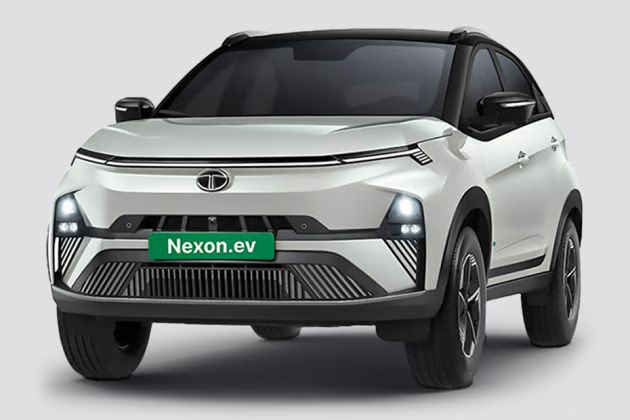
Introduction
The trend in India is rapidly shifting towards electric mobility, with consumers, producers, and the government being positive towards green mobility. The rising cost of fuel, pollution, and advances in EVs. The EV Cars in India market in India is experiencing rapid growth, with Indian manufacturers launching a range of EV models and international manufacturers entering the Indian automotive market. At the same time, it is becoming increasingly convenient for Indian consumers to own EVs with favorable government policies.
EV Adoption in India
- India’s electric vehicle market is registering a CAGR of over 40% and is estimated to reach millions of units of electric vehicles in 2025.
- Of all segments, Passenger EV has been growing at its fastest pace, and small SUVs and hatchbacks top this segment’s demand.
- The adoption rate among urban residents is higher, thanks to shorter charging distances during the day, among other things.
- Major automobile producers in India, such as Tata, Mahindra, and Ola Electric, are working towards increasing their offerings in the electric vehicle space.
- The rising entry of global electric vehicle brands (such as Hyundai and MG) is adding to competitiveness.
Significance of EVs for the Environment and Saving Costs
Environmental Benefits:
- EVs emit zero tailpipe emissions.
- Reduces carbon footprint, thereby helping to meet India’s climate commitments.
- Less noise pollution from EV motors’ silent engines.
Cost Savings:
- Lower operating cost: Electric Cars are much cheaper per km than petrol/diesel cars.
Reduced Maintenance:
- Reduced Use of Moving Parts
- No Engine Oil Required
- Fewer Brakes to Replace as a Result of Regenerative Braking
- Fuel Saving: Charging an electric vehicle at home or at public charging stations is cheaper compared to the cost of fuel.
Gov’t. Incentives, Subsidies, and Charging Infrastructure
- FAME India Scheme II: Provides subsidies on electric vehicles and charging points.
- Incentives specific to each state: Most states have waived road taxes and registration fees for electric vehicles, and some have offered subsidies to help people buy electric cars.
- GST benefits: The GST rate for Electric Vehicles is 5%, compared to 28% for traditional vehicles.
Charging infrastructure expansion:
- Number of public charging stations in metro cities.
- Development of fast-charging stations that enable charging times of 30-60 minutes or less.
- Tata Power, Fortum, and Ather Grid are among the corporate players heavily investing in EV charging.
- The long-term plan is for the government to install thousands of fast-charging points along highways to promote EV adoption.
Why EVs are the Future in India
India stands on the cusp of an electric mobility revolution, where economic, environmental, and technological factors intertwine. Rising fuel prices, coupled with EVs’ lower operating costs, have made them economically attractive to consumers. Ecological concerns, such as air pollution and carbon emissions, are pushing both citizens and policymakers toward cleaner modes of transportation. Backed by proactive government measures, including FAME II, tax rebates, and state-specific incentives, adoption is accelerating. At the same time, fast improvements in battery technology, fast charging solutions, and in-car connectivity ensure convenience and performance, making EVs a sustainable, innovative, and practical choice for modern Indian roads.
- Increasing Fuel Prices and Operational Cost Advantage of EVs: Reasons- high fuel prices; running cost advantage of the EVs end
- Thus, some of the main concerns are the regular rise in fuel prices, which has made running an ICE car unaffordable.
- The key attraction for EVs is the drastically lower cost per kilometer, typically 50–70% lower than petrol/diesel cars.
- It requires fewer maintenance costs due to fewer moving parts, no engine oil changes, and regenerative braking.
- EVs offer predictable operating costs because electricity rates are less volatile than fuel prices.
- Such long-term ownership savings can offset the higher upfront cost of EVs.


- EVs do not produce tailpipe emissions, thereby contributing to reduced pollution levels, especially in urban agglomerations.
- The contribution to reducing GHG emissions aligns with India’s goals under the Paris Agreement.
- Reduced noise pollution from silent electric motors in cities.
- EV adoption in dense urban areas reduces respiratory problems caused by smog, significantly improving public health.
- EVs powered by renewable energy offer even greater environmental benefits.
Government Push: FAME II Scheme, Tax Rebates, and State-Specific Incentives
- FAME India Scheme II provides incentives for purchasing EVs and installing charging infrastructure.
- Benefits of GST: While EVs attract 5% GST, conventional cars attract as high as 28% GST.
- State-specific incentives: Some states offer exemptions on road tax, registration fee waivers, and other subsidies.
- Policy support: The Government targets that by the year 2030, 30% of new vehicle sales should be electric.
- Encouragement of local battery and EV component production to cut down reliance on imports.
- Increased technological development: Improved batteries, quick recharging, and connectivity features.
- Improvements to batteries: higher energy density, longer lifespan, and better thermal management will enhance range.
- Fast charging: New DC fast chargers reduce charging time to 30–60 minutes for an 80% battery.
- Connected-car features include remote monitoring, app-based controls, and over-the-air software updates.
Regenerative braking increases efficiency and prolongs range.
- Smart Energy Management: Several electric vehicles integrate solar panels or home energy solutions for seamless charging convenience.
Types of EV Cars Available in India
The Indian electric vehicle sector offers buyers several options based on their requirements, ranging from electric to hybrid options that complement electric power with traditional fuel sources. The Battery Electric Vehicle could be considered fully electric, as it uses only a battery as its power source. In contrast, the Plug-in Hybrid Electric Vehicle uses both electric and petrol or diesel as fuel sources.
Battery Electric Vehicles: Fully Electric Cars
- Definition: A BEV relies on electric power from batteries only. It does not consume any petrol or diesel.
- India Examples: Tata Nexon EV, MG ZS EV, and Hyundai Kona Electric.
- Charging: Can charge the car either at home or using public charging points. Faster charging stations cut the charging time to just 30-60 minutes.
- Range: 200–500 km relative to its battery capacity.
- Handling: The instant torque translates to smooth acceleration.
Plug-in Hybrid Electric Vehicles (PHEVs) – Combination of Fuel + Battery
- Definition: PHEVs combine the features of a rechargeable battery and an internal petrol/diesel engine.
- Operation: Capable of operating with electric functionality over short-range journeys.
- Switch over to fuel operation over longer ranges.
- Charging: There is plug-in charging, but it also features regenerative braking, thanks to a petrol engine.
- Examples from India: The range is small at present, but upcoming models include the MG Hector Hybrid and the BMW iPerformance range.
- Range: Battery range 50-100 km, significantly increased in hybrid mode.
- Disadvantage: Higher cost due to increased battery size; more development is required to improve its efficiency. Advantage: Range anxiety eliminated; provides a transition model for
Comparison with Traditional ICE Cars – Cost, Maintenance, Performance
- Running Cost: EVS have running costs between 50-70% lower per km than petrol/diesel vehicles.
- Maintenance: EVs have less mileage-related wear and tear on brakes due to regenerative braking, or less mileage-related wear on brakes due to less mileage driven because of EVs having no engine oil
- Performance: Electric vehicles are known to provide smooth acceleration. Additionally, they do not make noise during operation.
- Fuel Dependency: ICE vehicles are powered solely by petrol or diesel; EVs are powered by electricity generated from renewable sources.
- Resale Value: Presently emerging; electric cars could retain value better as knowledge and acceptance build.
- Environmental Impact- One benefit of EVs is that they produce lower emissions and cleaner air than ICE vehicles.
Popular EV Models in India 2025
| Tata Nexon EV | ₹12.49 – ₹17.49 L (ex‑showroom) | ~325 – 489 km | Compact electric SUV with modern tech; updated variants include ADAS, premium trims; strong sales performance. |
| MG ZS EV | ₹22 – ₹26 L (approx.) | ~460 – 480 km | Premium SUV with spacious cabin, connected tech, panoramic options; facelift/upgraded 2025 variants expected. |
| Hyundai Kona Electric | ₹23 – ₹30 L (expected) | ~450 – 500 km | Smooth performance EV, fast charging support, premium comfort; upcoming refreshed models likely in 2025. |
| Mahindra XUV 7XO EV / Upcoming EVs | Expected pricing not yet confirmed | Not yet officially published | Mahindra’s XUV7XO set for early 2026 launch with advanced screens & ADAS features; various other EV variants in pipeline. |
| Ola Electric (Car Plans) | No passenger EV in the market yet | N/A | Currently focused on scooters & two‑wheelers; earlier car project paused — no confirmed 2025 EV car launch. |
- The Tata Nexon EV remains among the best-selling electric vehicles in India, with good sales and new safety/comfort features.
- The MG ZS EV remains a premium choice in the EV SUV segment, offering a higher range and a premium interior.
- The Hyundai Kona Electric is about to be refreshed with a stronger range and more features for 2025 buyers.
- The Mahindra XUV 7XO EV is an upcoming electric variant launching in early 2026 and promising advanced tech. However, exact pricing and specifications have not yet been officially shared.
- Ola Electric does not have an EV on sale in India in 2025. An earlier car project has been postponed, with the company focusing its energies on scooters/bikes.


Price Range of EV Cars in India
The Indian electric vehicle market offers a broad range. Whether it is a first-time vehicle, a mid-range electric vehicle that offers greater range and functionality for its price, or a high-end electric car that features high-tech features and extended range, there is an electric vehicle for everyone on the market. It is essential to know this to make the final purchase decision based on one’s budget.
Entry-Level EVs: ₹10-15 lakh
- Target market: First-time buyers of Electric Vehicles, Urban commuters, and Budget buyers.
- Range: Usually 250-330 km on a full charge, adequate for city driving.
- Characteristics: Basic infotainment systems, basic safety equipment, functional interiors.
- Charging: Typically offers DC home charging and relatively rapid public charging.
- Example of use: “The best models for everyday use are those that support daily commuting and short journeys. Cost-efficient vehicles
Mid-range EVs: ₹15 to 25 lakh
- Target Market: Families and tech-savvy consumers who look for a broader range and comfort.
- The main models: Higher variants of Nexon EV, MG ZS EV base/mid variants, others soon.
- Range: Normally ranging between 330 and 480 km.
- Benefits/Features: Infotainment, connected services, improved safety solutions, increased battery size
- Charging: Support for fast charging in public charging points (DC fast charging), better battery technology.
- Use Case: Suitable for Dual Usage – Urban and Highway Drives.
Luxury Electric Vehicles: above ₹25 lakhs & Luxury models:
- Audi e-tron: Target customers: Customers in the premium market, seeking the best-in-class and luxurious vehicles.
- Main models: Tops of MG ZS EV, Hyundai Kona Electric, and upcoming luxury electric vehicles.
- Range: Generally 450-550+ km. This is useful for long-range flights.
- Features: Upgraded interiors, advanced driver assistance systems, bigger batteries, fast-charging technology.
- Charging: Fast DC charging (30-60 minutes till 80% capacity), comprehensive battery guarantee.
- The use case: It is designed for buyers who value range, comfort, technology, or superior driving dynamics.
“Price vs. Range” – Comparative Table of Popular EV Models
- Tata Nexon EV: 12-17 lakh rupees, approximately 325-490 km range. The Tata Nexon Electric is another affordable vehicle that sells well.
- MG ZS EV: ₹22-26 lakh, ~460-480 km — Feature-rich SUV with ample space.
- Hyundai Kona Electric: ₹23–30 lakh | ~450–500 km – Smoother performance and range.
- Mahindra XUV EV (Unseen in India Yet) – Expected high range: Upcoming with high-tech features.
- Ola Electric Cars (Planned): TBA | TBA – If launched, expected to be competing in different segments.
- EV Charging Infrastructure
The charging infrastructure for EVs is developing rapidly to serve the growing number of EVs on Indian roads. Although a large number of EV owners continue to rely on home charging, publicly available charging stations are increasingly available in urban and highway areas of India. Current attention is focused on enhancing fast charging and encouraging government and private-sector investments to make EV ownership easier and more viable.
Home Charging: Charger Types, Installation Costs, and Charging Time
Domestic Chargers Types:
- Level 1 (AC Slow Charger): Easy to install; uses a standard household electrical outlet; ideal for overnight charging.
- Level 2 (AC Fast Charge): Needs a dedicated circuit and installation by a professional; charges EVs faster than Level 1.
Installation costs:
- Level 1 Chargers: Anything between ₹15,000 to ₹30,000 (plug
- Level 2 charging points: Approximately ₹50,000 to ₹2,00,000
Time to charge:
- Level 1: ~8-12 hours to fully charge. (Good for overnight charging.)
- Level 2: ~4-8 hours.
- Average Home Pricing Per Unit of Electricity: ₹6 to ₹10 in Indian states, depending on the electricity charges; relatively lower than public DC fast charging.
Public Charging: Presence in Urban Areas, Fast Charging Stations, Apps at Charging Stations
- Expansion of public charging networks: Thousands of public charging points in India are mainly located in cities such as Bangalore, Delhi, Mumbai, Chennai, and Karnataka.
- Fast Charging (DC Fast Charging or DC Fast): On a public rapid charger, a car will be able to charge an 80% battery in ~30-60 minutes.
Charging fees at public charging points:
- AC slow: ~₹10 – ₹14 lakh
- DC Fast: Approximately ₹18-22 per kilowatt-hour. It varies depending on the supplier.
Apps and tools:
- Specialized apps for electric vehicle charging (such as PlugShare, Tata Power EZ Charge, etc.) help consumers find charging points near them and plan routes based on charging locations.
- Community tools such as “RealChargerInfo” enable real-time updates about the status of charging stations (online or offline) reported by users.
Future Expansion Plans: State and Private Initiatives
- National Targets: Major expansion plans to install public EV charging infrastructure, including fast charging along the highway network, are under the PM E-Drive schemes, with budgets in the multi-thousand-crore range.
- Public–Private Partnerships: Cities like Ludhiana and Prayagraj are promoting the installation of hundreds of new charging stations through Public-Private Partnerships, where the concerned civic authorities provide the land as well as support in electricity supply.
- State Initiatives: Several state administrations (Delhi, Maharashtra, Uttar Pradesh, and others) are working to install a large number of charging points at appropriate locations.
- Automaker Engagement: Tata Motors and its collaborators are expected to scale up charging infrastructure exponentially to offer many tens of thousands of new charging points across all models of Electric Vehicles. The charging points will be in the form of Mega Charger Hubs.
- Grid and Policy Support: Government EV charging policies facilitate the installation of public charging stations by enabling favorable electricity rates and land-use terms that encourage the development of supporting infrastructure.
EV Range and Performance
The growing trend of electric vehicles in Indian markets should be assessed not only on cost and specifications but also on actual mileage and performance. Although car makers are claiming impressive mileage in standardized test drives, actual performance in Indian traffic conditions may differ due to factors such as traffic, driver behavior, road terrain, and environmental conditions. Nevertheless, new-generation electric vehicles offer smooth acceleration, rapid torque response, and a pleasurable driving experience.
Acceleration & Range of Popular EVs Available in India
- Instant torque: The time taken to accelerate from 0 to 100 km/hr: Tata Nexon EV, MG ZS EV, and Hyundai Kona Electric accelerate within 7 to 10 seconds.
- Smoother ride: Electric motors provide smooth, quiet operation with no lag when power is transmitted to the wheels.
- Regenerative braking: enhances efficiency and provides a distinct braking method.
- Urban driving versus highways: EVs handle better in urban traffic, with rapid acceleration and braking, though high speeds can impact range—smooth driving.
- Handling & Stability: Today’s EVs have a lower center of gravity owing to battery placement, which enhances handling and stability.
- For example, in the Tata Nexon EV Sportz variant, the acceleration from 0 to 100 km/h takes 9.9 seconds, while in the MG ZS EV, it takes 8.5–9 seconds, and in the Hyundai Kona Electric, it takes 7.6 seconds.
Pros and Cons of Owning an EV in India
Owning an electric car in India offers several advantages, but also presents some hurdles for buyers. Electric vehicles are affected by “range anxiety” due to a lack of charging points and a relatively higher price.
Advantages of Having an EV in India
- The cost of running is low because electricity is cheaper than fuel, hence it is cost-effective.
- Low Maintenance: There are fewer moving components, with no engine oil changes needed, and regenerative brakes.
- Government Subsidies & Taxation Incentives: Such as the FAME II Scheme, GST Slab Reductions, and State-level Taxation Incentives
- Environmental Impacts: Electric cars produce zero tailpipe emissions, helping reduce overall emissions.
- Smooth and Quiet Ride: EVs offer a smooth, quiet ride thanks to instant torque, smooth operation, and comfort on both urban and highway routes.
- Future-proof technology: Most electric cars offer features such as internet connectivity, over-the-air updates, and enhanced safety features.
Drawbacks of Possessing an EV in India
- Range Anxiety: Not having enough battery life when traveling longer distances, and less access to charging stations.
- Inadequate charging infrastructure in small cities and rural areas: Although charging points are increasing in cities, fast-charging hubs remain scarce in rural and semi-urban areas.
- Higher purchase price: EVs are relatively pricier than their ICE counterparts, but the long-term savings offset this cost.
- Charging time: It will still take 30 to 60 minutes to reach 80% capacity, which is much longer than filling petrol or diesel.
- Battery Degradation – Over time, the battery’s efficiency and range can degrade, thereby affecting its resale value.
Future of EVs in India
The prospects for electric vehicles in the Indian market are poised to become ever more dynamic and exciting in the coming period as the industry shifts from the early-adopter phase to gaining acceptance in the mainstream. What the next couple of years – and from 2025 into 2026 – will bring in terms of an influx of electric vehicle models into the market is expected to change the face of the automotive industry in India.
Models in 2025-2026
- Tata Sierra EV: It is an all-electric SUV that should arrive by early 2026, catering to varied requirements with multiple battery choices.
Toyota Urban Cruiser EV
- A new electric offering is set to enter the market shortly, likely to share its platform with the Maruti e-Vitara electric variant, targeting the mid-range SUV.
- VinFast Limo Green: It is a 5+2 seater electric MPV with a target range of ~450 km.
- A compact SUV due around mid-2026, focusing mainly on the mid-market segment of electric vehicles.
- Hyundai Ioniq 5 (Facelift): Upgraded to have larger batteries and better range, aimed at the premium segment of electric car buyers.
- Maruti Suzuki eVX & Other EVs: Various global and local brands, including Maruti Suzuki, are gearing up to launch EVs in late 2025 or 2026.
Anticipated Advances in Battery Technology, Range, and Charging Times
- Higher energy density: Next-generation batteries promise greater energy capacity, enabling longer driving ranges without the need for larger batteries.
- Faster charging speeds: As more DC fast chargers of higher power ratings are put into service, charging times will decrease substantially, making it easier to travel long distances using electric vehicles.
- Reduction in battery prices: Increased localized battery manufacturing and the upcoming gigafactories will lower battery costs, thereby directly impacting EV costs.
- Better thermal and performance management: This will ensure that EV batteries are adequately cooled and that management systems are optimized to maintain consistent range levels regardless of weather and driving conditions.
Market Trends: EVs, Growth in Adoptability
- Increasing adoption: The number of EVs used for passenger transport is rising as models become more widely available, making them more comparable in cost to traditional vehicles.
- More competition: The entry of Global Brands like Toyota, Kia, and VinFast, along with an expanding product range from Indian OEMs like Tata and Mahindra, is presenting more choices.
- Government Support: Policies and incentives remain dynamic, with new state-level EV policies emerging that offer subsidies, scrappage schemes, and plans for charger infrastructure development, thereby creating a positive framework for electric vehicle adoption.
- Manufacturing push: Localisation projects and manufacturing schemes (such as PLI schemes for EV technology) are promoting indigenous EV manufacturing and reducing dependence on imports.
Conclusion
The advantages include low operating costs, minor maintenance, government subsidies, and low emissions. The cons include range anxiety, a lack of charging points in small cities, and the cost of buying an electric car. The benefits outweigh the costs, and this attracts many customers.
The entry-level Electric Vehicles would be most suitable for city travelers and those preferring shorter journeys. Mid-level electric vehicles would be ideal for those who prefer range, comfort, and features, especially families. The high-end Electric Vehicles would be for buyers seeking highway range, technology, and luxury.
Although the charging costs are initially high, the long-run savings, combined with the benefits of a cleaner environment and the ever-increasing support infrastructure, make EVs a very rational and progressive decision for the future. As the EV industry develops in India, adopting the technology not only saves money but also places customers at the vanguard of a clean, sustainable, and progressive car industry for the future.
FAQs
- What is the longest-range EV car model in India in 2025?
As of now, top electric vehicles such as the Hyundai Ioniq 5, Kia EV6, and BYD Atto 3 offer the highest range in India, ranging from 450 to 500 km on a single charge.
- Which is the least expensive EV car present in India?
The lowest-priced electric cars in India are the Tata Tiago EV and MG Comet EV, with starting costs of around ₹6.99-7.99 lakh, making them perfect for first-time car buyers.
- What does it cost to charge an electric vehicle at home?
The cost of charging an EV in a domestic setup ranges from ₹6 to ₹10 per kilowatt-hour. It will require a 30-40 kWh battery. Hence, charging the battery will cost around ₹180-₹400. This is much lower compared to running a diesel/petrol car.
- Are EVs a good purchase in India for 2025?
Yes, EVs are definitely worth considering for purchase because of lower operating costs, easy maintenance, government rebates, and other benefits that help keep the environment clean. Even though the acquisition price for such vehicles is relatively high, it is definitely worth it.
- What are the expected timelines for launching newer model Electric Vehicles in the Indian market?
In 2025 & 2026, several new EVs will be launched, including the Tata Sierra EV, Kia Sorento EV, Hyundai Ioniq 5 facelift, and Maruti Suzuki eVX, among others. The exact launch timeline is 2025, with a few in early 2026.