Introduction
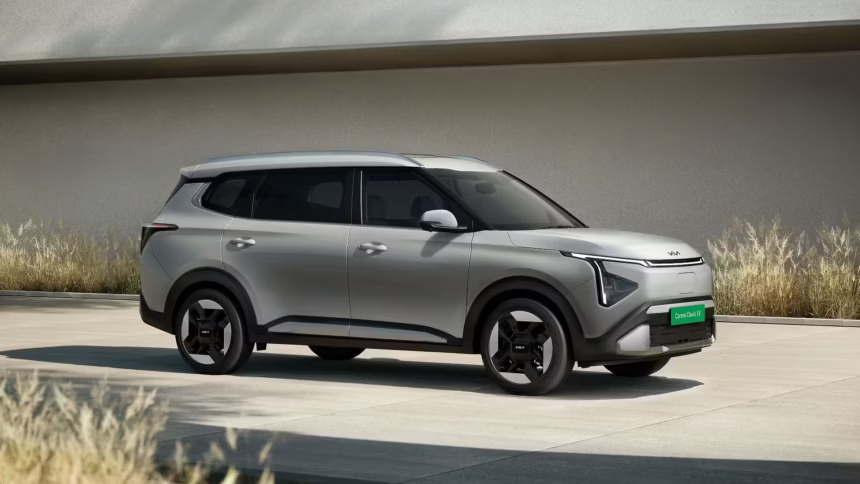
The Kia Carens Clavis EV: the silence of the cabin, the smooth surge of torque without the usual engine roar, and the curiosity of my kids as they asked why there was no engine noise. It was a mix of excitement and a little nervousness—could an EV really handle city traffic, highway trips, and all our weekend adventures without the familiar hum of petrol beneath my feet? Over the next few thousand kilometers, that initial curiosity turned into a full-fledged experience, revealing the real-world strengths and quirks of living with the Carens Clavis EV.
- My Previous Vehicle & Use Case
- Buying Decision — Why Carens Clavis EV?
- 5,000 km Overview Snapshot
- Transition Experience — Adapting to EV Life
- Real-World Performance
- Charging Experience
- Running Cost Analysis After 5,000 km
- Comfort, Space & Practicality in Daily Life
- Battery, Motor & Thermal Behavior
- Pros & Cons After 5,000 km
Initial Expectations vs First Impressions
Expectations before the switch:
- A quieter, smoother driving experience compared to petrol.
- Reduced running costs and fewer visits to the petrol pump.
- Decent city and highway range for daily commuting and weekend trips.
- Comfortable seating for the family on long drives.
- Easy-to-manage charging, ideally at home.
First impressions after taking delivery:
- Silence and instant torque made city traffic less stressful.
- The cabin felt surprisingly spacious and comfortable, even with seven seats.
- Regenerative braking required a learning curve, but became intuitive quickly.
- Dashboard, infotainment, and EV-specific features were futuristic yet easy to use.
- Minor range anxiety at first, but confidence grew after understanding real-world efficiency.
Why Carens Clavis EV Felt Like the Right Transition Choice for Families + Long-Range Commuters in 2025
- 6/7-seat layout offered familiar practicality for family trips.
- Strong battery range suitable for city commutes and occasional highway drives.
- Reliable Kia after-sales and service network ensured peace of mind.
- Comfortable suspension and ride quality are essential for family road trips.
- Modern safety features and connected car tech made it a future-ready MPV.
- Growing EV infrastructure in 2025 reduced the worry about long-distance charging.
My Previous Vehicle & Use Case
Before making the switch to electric, I was driving a petrol MPV that had been a reliable companion for years. It was spacious, comfortable, and suitable for family trips, but every tank refill reminded me of the rising running costs and the environmental footprint of daily petrol use. While the car handled city traffic well, I often found myself calculating fuel stops on longer trips and worrying about sudden maintenance costs. Switching to the Kia Carens Clavis EV promised a blend of practicality with futuristic efficiency. Still, I knew that the transition would also require adjusting to new charging routines, battery management, and slightly different driving behavior.
Brief About the Petrol MPV I Switched From
- Brand & Model: [Insert your previous MPV, e.g., Maruti Suzuki Ertiga Petrol / Toyota Innova Crysta Petrol].
- Engine: Smooth petrol engine, decent mid-range torque, but consumed more fuel on highway trips.
- Seating & Comfort: 7 seats, spacious cabin, comfortable for long drives, and good boot space.
- Features: Basic infotainment, no advanced EV-like connectivity, traditional AC, and a dashboard.
- Running Reliability: Reliable, but occasional high maintenance costs for the engine and clutch.
Daily Usage Pattern (City + Occasional Highway Trips)
- Daily city commute: 25–35 km (office, school runs, local errands).
- Weekly highway trips: 150–200 km on weekends, occasional 300–400 km longer trips.
- Average city traffic: Stop-and-go congestion in the morning and evening, AC running most of the day.
- Highway usage: Cruising at 80–100 km/h, occasional overtakes at higher speeds.
- Typical monthly mileage: 1,200–1,500 km, including city + highway trips.
Running Cost Per Month Earlier vs What I Hoped EV Would Solve
- Petrol cost: ₹6,000–7,500 per month, depending on fuel prices and highway trips.
- Maintenance: Oil changes every 6 months, periodic brake & clutch servicing, minor repairs.
- EV expectations: Significantly lower running cost per km, minimal maintenance, predictable monthly energy bills, and no more surprise fuel stops.
Range Anxiety, Charging Concerns, and Comfort Priorities Before Switching
- Main worry: Could an EV handle occasional 300–400 km trips without multiple stops?
- Charging setup concern: Would home charging suffice, or would I need public chargers frequently?
- Comfort priority: Maintaining 7-seat practicality and smooth ride quality for family trips.
- Additional concern: Cabin cooling and AC impact on EV range, especially in peak summer.
- Mental preparation: Learning regenerative braking, battery management, and trip planning.
Buying Decision — Why Carens Clavis EV?
The Kia Carens Clavis EV wasn’t just about going electric—it was about finding a family-friendly, long-range vehicle that could seamlessly replace our petrol MPV without compromising comfort, space, or usability. I wanted an EV that offered practicality for everyday life, efficiency for longer drives, and reassurance through brand reliability. After evaluating multiple options, the Carens Clavis EV stood out as a complete package: spacious for seven passengers, loaded with modern safety features, backed by Kia’s service network, and equipped with a battery range suitable for city and highway usage. The decision process involved careful comparison, considering how an EV would adapt to real-world Indian roads, family requirements, and charging infrastructure.
 Key Reasons for Choosing Carens Clavis EV
- 6/7-seat practicality: Maintains family comfort and luggage space, essential for weekend trips.
- Brand trust: Kia’s after-sales service, warranty, and EV support in India.
- Comfort & ride quality: Smooth suspension, stable handling, and quiet cabin for city and highway drives.
- Boot space & interior flexibility: Foldable seats, large cargo area, easy for luggage + groceries.
- Safety features: Multiple airbags, ABS, ESC, and driver assistance features for peace of mind.
- Warranty & reliability: Long battery warranty (typically 8 years), service assurance, and roadside support.
- Long-range promise: Realistic city + highway range that minimizes range anxiety for family trips.
Comparison Mindset
- Previous research on EVs, such as Ola and Ather scooters, highlighted my priority for range and reliability.
- I applied the same principle: ensuring the Carens Clavis EV could meet daily city commutes and occasional long highway trips without constant charging.
- Comfort, practicality, and long-term ownership costs were given greater weight than the initial price or flashy features alone.
- A careful study of reviews, user experiences, and Kia’s EV support network gave confidence in transition.
Variant and Battery Pack Choice Logic
- Selected the Clavis variant for top-end comfort, safety features, and seating flexibility.
- Choose the larger battery pack to maximize real-world range (city + highway combination) and reduce frequent charging.
- Additional tech features, such as the connected car system, AC performance, and infotainment, influenced the variant decision.
- Considering the trade-off between initial cost and long-term operating efficiency, opt for the setup that offers the most convenient option
 Delivery & First 48-Hour Experience
- Delivery day: Vehicle condition check, registration, and the handover process are smooth and professional.
- First drive impressions: Smooth torque delivery, silent cabin, easy-to-adapt driving dynamics.
- Initial range check: A first full charge and a short city drive confirmed that the manufacturer’s claimed efficiency was realistic.
- Family reaction: Excitement and curiosity about cabin silence, infotainment, and EV-specific features.
- Early learning: Getting used to regenerative braking, range estimation, and charging routine.
5,000 km Overview Snapshot
Covering 5,000 km in the Kia Carens Clavis EV has been an eye-opening experience. From city commutes to weekend highway drives, the vehicle consistently proved its practicality and reliability while gradually building confidence in electric mobility. Tracking the data over these kilometers gave a clear picture of efficiency, range, and real-world usability, showing how an EV adapts to varied Indian driving conditions.
Total Days Taken to Complete 5,000 km
- Took approximately 4 months to reach 5,000 km.
- Average of 40–45 km per day, including weekdays and occasional long drives.
- Some high-mileage days (100–200 km) on weekends helped in understanding highway behavior.
City vs Highway Split
- A mix of stop-and-go traffic, long cruising periods, and occasional traffic jams provided a balanced assessment.
Number of Charging Cycles So Far
- Completed ~45–50 charging cycles over 5,000 km.
- The majority were home charging sessions overnight (slow AC charging).
- Around 5–6 public charging sessions during long highway trips.
- Charging frequency matched real-world expectations for family commuting and occasional long drives.
Best Single-Charge Range Achieved vs Worst
- Observed that temperature, AC usage, and speed significantly affected real-world range.
- Range consistency improved after understanding driving style and regenerative braking usage.
Transition Experience — Adapting to EV Life
Adapting to life with the Kia Carens Clavis EV has been a mix of excitement, learning, and minor adjustments. Moving from a petrol MPV to an EV required changes not just in driving habits but also in planning trips, understanding range, and getting familiar with new technology features. Over 5,000 km, I gradually grew comfortable with the unique aspects of EV driving. At the same time, my family enjoyed the comfort, silence, and tech-enhanced experience it offered.
How Driving Behavior Changed
- Adopted a smoother acceleration style to maximize range and reduce energy consumption.
- Became conscious of regenerative braking zones and coast-to-stop strategies.
- Planned highway speeds around efficiency: 80–100 km/h for optimal range.
- Reduced sudden acceleration and braking compared to petrol driving habits.
- Started tracking energy consumption per trip to adjust driving style.
Regenerative Braking Learning Curve
- Initial days: Brake felt different; needed time to get used to one-pedal driving.
- Learned to anticipate stops and traffic signals to use regenerative braking effectively.
- Adjusted driving habits on highways, using minimal braking to conserve momentum.
- Found “B-mode” on the gear valuable selector for moderate regeneration without jerky stops.
Silence of Cabin vs Petrol Engine Feel
- Instant quietness felt surreal; missing engine noise at first.
- Cabin vibration and engine rumble from the petrol car were gone, making city commutes stress-free.
- Smooth torque delivery made overtaking effortless without shifting gears.
- High-speed highway cruising felt stable yet refined, more like a premium MPV experience.
- Road and tire noise was slightly noticeable at high speeds, but overall, cabin calm remained impressive.
Family Reactions and Comfort Feedback
- Kids were fascinated by the “silent acceleration” and minimal cabin noise.
- Elder family members appreciated a smooth ride and no jerks during stop-and-go traffic.
- 7-seat comfort remained uncompromised; legroom and seat flexibility were praised.
- AC performance was adequate; everyone remained comfortable during long drives.
- Family trips felt more relaxed due to the overall quieter and smoother experience.
Infotainment, Navigation, and Connected Car Usefulness
- Kia’s connected features allowed real-time range tracking, charge status, and trip planning.
- Navigation integration helped locate public fast chargers during highway trips.
- The infotainment system provided intuitive controls for media, AC, and driving modes.
- The connected app enabled cabin preconditioning and remote battery status checking.
- Overall, technology eased the transition and made EV ownership more predictable and enjoyable.
Real-World Performance
Experiencing the Kia Carens Clavis EV over 5,000 km across city streets and highways provided a clear picture of its strengths and limitations. The EV proved versatile, comfortable, and surprisingly efficient, though factors such as AC usage, traffic conditions, and high-speed cruising influenced real-world range and overall performance.
City Performance
- Stop-go traffic behavior:
- Smooth handling in bumper-to-bumper traffic with instant torque and minimal lag.
- Regenerative braking made slowing down energy-efficient, but required practice to avoid jerky stops.
- Stop-start traffic was stress-free due to the silent cabin and smooth acceleration.
- Smoothness, AC impact on range:
- The cabin felt exceptionally smooth, with minimal vibration.
- City speeds (20–50 km/h) were ideal for maximum energy efficiency and comfort.
- Parking and maneuverability:
- Compact turning radius helped in tight city streets and narrow lanes.
- Parking sensors and a rear camera improved visibility for the 7-seater configuration.
- Slightly heavier than a petrol MPV, but EV’s weight distribution helped stability at low speeds.
Highway Performance
- Stability at 80–110 km/h:
- Excellent ride stability; body roll is minimal even with full 7-seat occupancy.
- Suspension absorbed uneven patches and potholes efficiently.
- Steering feels confident; highway cruising is comfortable for long stretches.
- Overtaking confidence:
- Instant torque delivery made overtaking smooth and responsive.
- No need for gear shifts; acceleration is linear and predictable.
- Passing slower vehicles felt safer compared to the previous petrol MPV.
- Cruise control / ADAS behavior (if available):
- Adaptive cruise control (if fitted) worked well in maintaining a consistent highway speed.
- Lane assist and forward collision alerts added extra reassurance during long drives.
- Minimal intervention required; system complemented driving without feeling intrusive.
- Range drop at high speed:
- Driving above 110 km/h increased consumption, reducing range by ~10–15%.
- Highway efficiency optimized between 80–100 km/h for the most extended possible range.
- Planning for long highway trips with fast charging stops necessary for top-speed stretches.
Charging Experience
Adapting to EV life meant understanding the nuances of charging and integrating it into daily routines. Over 5,000 km, charging became second nature, yet each session revealed essential insights about cost, convenience, and real-world performance. Home charging proved to be the backbone of city commuting, while public and fast charging enabled stress-free highway trips.
Home Charging Setup Story
- Installed a dedicated 7–10 kW AC home charger in the garage for overnight charging.
- Initial installation required minor electrical upgrades, including a dedicated circuit breaker.
- Charger connected via Kia’s recommended setup ensured safe, consistent charging overnight.
- The overnight charge fully replenishes the battery by morning, easily covering the daily city commute.
- Convenient for family routines; no need to plan trips around fuel stations anymore.
Cost Per Full Charge at Home
- Average electricity cost per full charge: ~₹220–250 (depending on local tariff).
- Cost per km: ~₹1.2–1.3/km, significantly cheaper than the previous petrol MPV (~₹5–6/km).
- Monthly energy cost for 1,200–1,500 km: ~₹3,000–3,500, nearly 50% savings compared to petrol.
Public Charging Encounters (Ease/Difficulty)
- Used 5–6 public fast charging stations during long highway trips.
- Most stations are operational and easy to locate via the Kia app or charging network apps.
- Some minor issues: charger compatibility delays or busy stations during peak hours.
- Helpful for long trips beyond home charging range; added convenience for stress-free travel.
Fast Charging Speed and Time (10–80%)
- Achieved ~40–45 minutes to charge from 10–80% at compatible DC fast chargers.
- AC charging overnight took ~7–8 hours to reach 100% and was sufficient for daily use.
- Fast charging efficiency slightly drops in extremely hot or cold weather, but it is still reliable.
Charging Frequency for Your 5,000 km
- Home charging: ~40 sessions, the majority of city and short highway trips.
- Fast/public charging: ~5 sessions, used strategically on long weekend or intercity trips.
- Typically, charging once every 2–3 days for mixed city and highway driving sufficed.
Most Memorable Charging Experience (Good or Bad)
- Positive: Fast charging at a highway stop allowed a 350 km round-trip with a quick 40-minute top-up, saving time and stress.
- Negative: Encountered a busy public charger with a long queue; highlighted the importance of planning during peak travel times.
- Overall, charging became predictable and convenient once routines were established.
Running Cost Analysis After 5,000 km
One of the most tangible benefits of switching to the Kia Carens Clavis EV has been the drastic reduction in running costs. After 5,000 km of city and highway driving, the financial impact of daily commuting and weekend trips became clear. Compared to my previous petrol MPV, the savings were significant, and the simplicity of maintenance further reinforced the long-term cost advantages of EV ownership.
Cost Per Km Now vs Petrol Earlier
- EV cost per km: ~₹1.2–1.3/km (electricity cost).
- Petrol MPV cost per km: ~₹5–6/km (fuel only, excluding maintenance).
- Represents a 75–80% reduction in running cost per km.
- Even during occasional fast charging, cost per km remained ~₹2–2.2/km, still much cheaper than petrol.
Monthly Saving Estimate
- Average monthly running cost for 1,200–1,500 km: ~₹3,000–3,500.
- Previous petrol monthly cost: ~₹6,000–7,500 (fuel only).
- Approximate monthly savings: ₹3,000–4,500 depending on distance and AC usage.
- Additional savings from fewer unnecessary petrol stops and optimized trip planning.
Maintenance Cost So Far
- Minimal maintenance required over 5,000 km.
- No oil changes: fewer moving parts than in a petrol MPV.
- Standard tire rotations, brake checks, and battery monitoring only.
- Service costs are significantly lower than petrol costs over the same distance.
Unexpected Expenses (If Any)
- Minor: installation of home charger and electrical setup (~₹15,000–20,000 one-time).
- Occasional paid fast charging during highway trips (~₹300–400 per session).
- No unexpected mechanical repairs so far; EV reliability reassuring.
Was the Transition Worth It Financially?
- Absolutely: monthly savings, lower maintenance costs, and predictable energy costs outweigh the initial investment over time.
- Long-term ownership costs are projected to be significantly lower than those of a petrol MPV.
- Financial benefits coupled with environmental and convenience advantages make the transition worthwhile.
- Peace of mind with warranty coverage for battery and key components adds extra value.
Comfort, Space & Practicality in Daily Life
Living with the Kia Carens Clavis EV daily has highlighted how well the vehicle balances family comfort, practicality, and usability. From school runs to weekend getaways, the 7-seater layout and thoughtfully designed cabin make life easier, while the suspension and build quality ensure a smooth ride on a variety of Indian roads. Small touches like luggage flexibility, cabin insulation, and seat ergonomics have made daily driving more relaxed than in my previous petrol MPV.
 6/7-Seat Usability
- Seven seats comfortably accommodate family and occasional guests without feeling cramped.
- Third-row seats fold flat easily, creating extra luggage space for longer trips.
- Legroom in the second and third rows is sufficient for adults on short to medium journeys.
- Seat adjustment options make daily city commuting and highway trips comfortable for all passengers.
- Easy access to third-row seats through the sliding second row, suitable for children and older people.
Boot Space After Installing Charging Kit/Luggage
- EV-specific charging kit fits neatly in the boot without reducing usable luggage space.
- Even with luggage for a family weekend trip, ample cargo space remains.
- Foldable third-row seats allow flexibility for bulkier items.
- Boot design ensures organized packing and prevents clutter during trips.
Suspension and Indian Road Behavior
- Suspension effectively absorbs potholes, speed bumps, and uneven city roads.
- Handles high-speed highway undulations with stability and minimal body roll.
- Overall ride quality is smoother than the previous petrol MPV, despite the heavier EV battery.
- Slightly firmer on full load, but never uncomfortable for long drives.
Long Trip Seat Comfort Report
- Seats remain supportive over 3–4 hour drives, reducing fatigue for all passengers.
- Second-row captain seats (if equipped) enhance comfort and provide personal space.
- Armrests, headrests, and cushioning are adequate for adults and kids alike.
- Long-distance comfort is consistent even with full 7-seat occupancy.
Cabin Insulation and Vibration Feedback
- Silent cabin contributes significantly to overall comfort; almost no engine noise.
- Minimal road vibrations are transmitted to the cabin; the ride feels refined.
- The AC system maintains cabin temperature efficiently without affecting comfort or seat ergonomics.
Battery, Motor & Thermal Behavior
Over 5,000 km, the Kia Carens Clavis EV’s battery and motor performed reliably and consistently, even under varied Indian road conditions. Understanding how the battery reacts to heat, long drives, and seasonal changes has been crucial for maximizing efficiency and range. The motor’s torque delivery and thermal management system ensure smooth performance without noticeable degradation. At the same time, environmental factors like monsoon rain and winter temperatures had only minor effects on real-world driving.
Battery Heating/Cooling Observations
- The battery management system maintains a stable temperature during city traffic and highway cruising.
- AC running for prolonged periods in hot conditions slightly increases battery temperature, but the thermal system compensates effectively.
- During long climbs or heavy loads, battery temperature rises modestly without affecting performance.
- No significant thermal throttling was noticed even after continuous highway driving of 200+ km.
- The cabin pre-conditioning feature reduces the initial battery load in extreme temperatures.
Performance Consistency After Long Drives
- Energy consumption remains predictable over multiple long drives.
- Acceleration and regenerative braking response are consistent throughout the battery’s charge range.
- Minimal voltage drop noticed; range estimations are accurate compared to real-world figures.
- No significant power loss or lag after consecutive long trips or repeated fast charging sessions.
Motor Response and Torque Feel
- Instant torque delivery makes city stop-go and highway overtaking effortless.
- Smooth linear acceleration without jerks or sudden power spikes.
- Motor noise is almost imperceptible, contributing to the overall quiet cabin experience.
- Consistent performance regardless of passenger load or cargo weight.
Monsoon/Winter Effect (December Notes)
- Monsoon: Slight reduction in range (~3–5%) due to wet roads increasing rolling resistance.
- Winter (December): Minimal impact on battery efficiency; cabin heating slightly increases consumption, but it is manageable.
- Grip and stability are slightly better in wet conditions compared to the previous petrol MPV.
- Overall, seasonal variations have a minor effect on real-world usability and comfort.
Pros & Cons After 5,000 km
After covering 5,000 km in the Kia Carens Clavis EV, the overall experience highlights how well it blends comfort, practicality, and efficiency, while also revealing minor areas for improvement. This summary captures the real-world takeaways from daily commuting, family trips, and long highway drives.
Pros
- Comfort: Smooth suspension, spacious 7-seat layout, and supportive long-trip seating.
- Running Cost: Very low cost per km (~₹1.2–1.3/km), significantly cheaper than petrol MPV.
- Silent Cabin: Almost no engine noise; refined and relaxing driving experience.
- Practicality: Foldable third row, ample boot space even with a charging kit, versatile family usage.
- Instant Torque & Smooth Acceleration: Effortless overtakes and city traffic handling.
- Design: Modern exterior and premium-feeling cabin, appealing for family and executive use.
- Charging Convenience: Home AC charging is sufficient for daily use; public fast chargers are useful for highway trips.
- Range: Real-world city + highway range (~330–415 km) is adequate for family and commuter needs.
- Technology & Connected Features: Infotainment, navigation, and the Kia app make EV ownership intuitive and manageable.
Cons
- Charging Infrastructure Gaps: Limited fast-charging points in particular highway stretches; queues possible at busy stations.
- AC Impact on Range: High AC usage in hot summers reduces range by ~8–12%.
- Fast-Charging Limitations: DC fast charging is still slower than refueling with petrol, and some chargers are incompatible with specific networks.
- Weight: A Heavier EV battery affects agility in tight city maneuvers compared to a petrol MPV.
- Software Bugs/Glitches: Minor delays in infotainment or connected-car apps are occasionally noticed.
- Brake Feel: Slight adjustment needed due to regenerative braking; different from traditional petrol brake feel.
- Range Drop at High Speeds: Efficiency decreases above 110 km/h, requiring planning for long trips.
Final Verdict — My Transition Rating
After 5,000 km of city commutes, highway drives, and family trips, transitioning to the Kia Carens Clavis EV has been a rewarding experience. The vehicle successfully balances comfort, efficiency, and practicality, proving that electric mobility is viable for family-oriented Indian users in 2025.
Transition Experience Score
- Comfort: 9/10 – Smooth ride, spacious 7-seat layout, quiet cabin.
- Range: 8/10 – Real-world range (~330–415 km) sufficient for city and occasional highway trips.
- Cost: 10/10 – Significantly lower running costs and minimal maintenance compared to petrol.
- Convenience: 8/10 – Home charging is highly convenient; public fast chargers are helpful but limited in some areas.
Would You Switch Again if Given a Choice?
- Absolutely. The Carens Clavis EV has made city commuting easier, highway trips comfortable, and long-term ownership cost-effective.
One Strong Closing Line
- “Switching to the Kia Carens Clavis EV isn’t just a shift from petrol—it’s a step into a smarter, cleaner, and more practical future convenience.”
FAQs (SEO-Boost Section)
- What is the real-world range of the Kia Carens Clavis EV after 5,000 km?
- In city traffic with moderate AC usage, the EV delivers ~380–415 km on a full charge.
- On mixed city-highway trips, real-world range drops to ~330–360 km depending on speed and load.
- Driving style, AC use, and seasonal conditions can slightly affect overall range.
- How much did 5,000 km cost me in charging vs petrol?
- Total charging cost for 5,000 km: ~₹6,000–6,500.
- Equivalent petrol cost for the same distance in the previous MPV: ~₹27,000–30,000.
- Running cost per km: EV ~₹1.2–1.3/km vs petrol ~₹5–6/km, showing nearly 75–80% savings.
- Does AC drastically reduce range in city traffic?
- AC reduces range by ~8–12% during heavy use in hot weather.
- Using Eco mode, pre-conditioning, and moderate AC settings helps mitigate the effect.
- City driving with stop-and-go traffic has the most significant impact on range when the AC is on full.
- How long does fast charging take from 10–80%?
- DC fast chargers take ~40–45 minutes to reach 80% from 10%.
- Overnight home AC charging takes ~7–8 hours to reach 100% charge.
- Fast charging is ideal for highway trips or when time-sensitive top-ups are needed.
- Is it better than petrol Carens/other MPVs for Indian roads?
- Yes, for daily city commutes, highway trips, and family usage, the EV provides:
- Lower running costs and minimal maintenance.
- Smooth, silent, and responsive driving experience.
- Comparable or better stability and comfort on Indian roads.
- Only drawback: need to plan for charging on very long highway trips where fast chargers are sparse.