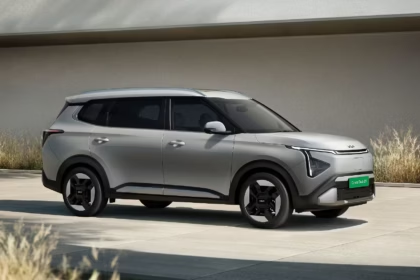
In India, the electric car market is growing very fast. People are shifting towards electric vehicles because of rising petrol and diesel prices and increasing environmental concerns. In this market, one name that feels both emotional and exciting for many people is the Tata Sierra EV.
- Tata Sierra EV 2026: Overview
- Tata Sierra EV Exterior Design & Styling (In-Depth)
- Sharp Headlamps
- Battery Pack & Performance (Detailed Analysis)For anyone buying an electric SUV, the biggest questions are: “What will be the range?” and “How will the performance feel?
- Drive Modes & Energy Management
- Features & Technology (Detailed Explanation)Nowadays, in the ₹25–30 lakh segment, range and design alone are not enough. Buyers expect the car to be fully loaded with safety, technology, and comfort features.
In the 1988s, the Tata mobile (Sierra) was a very unique SUV. Its special glass design and bold look were quite advanced for that time. Now, Tata Motors is bringing back this iconic name in a new electric version.
In this article, we will understand in detail what the Tata Sierra EV can offer — including its design, driving range, expected price, features, charging options, and comparison with rivals — all explained in simple language.
If you are planning to buy a premium electric SUV in the ₹25–30 lakh budget, this blog will be helpful for you.
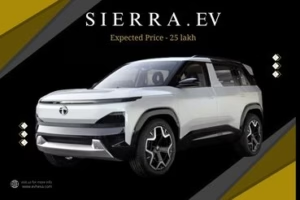
Tata Sierra EV 2026: Overview
Tata Sierra EV was first shown by Tata Motors in concept form at the Auto Expo. The concept version grabbed a lot of attention because it was not just a new electric SUV — it was a modern comeback of the iconic 1990s Tata Sierra.
The concept model showed a futuristic design, a glass-heavy side profile, and a premium cabin layout. After that, Tata confirmed that the Sierra EV would be brought into production. Based on industry reports and company statements, there is a strong possibility that it could launch around 2026.
Platform & Technology Base :
Tata Sierra EV will be based on Tata’s new-generation EV architecture. It will use a dedicated electric platform, which means it will not be converted from a petrol or diesel car.
Because of this, it will have several advantages:
- The battery will be placed under the floor, which will give more cabin space.
- The car will have a lower center of gravity, which will improve stability.
- Structural safety will be better.
This platform will also be future-ready. It will support OTA (over-the-air) updates and advanced driver assistance systems (ADAS).
Target Segment
Tata Sierra EV will be positioned above the Tata Nexon EV by Tata Motors. It will come in the mid-size premium electric SUV segment.
Expected Segment:
- Its size will be close to the Tata Harrier.
- It will target premium family SUV buyers.
- It will focus on long driving range and strong, bold design.
This SUV will attract buyers who want a stylish, spacious, and future-ready electric SUV in the ₹25–30 lakh budget range.
Role in Tata’s EV Strategy
Tata Motors already has a strong position in India’s EV market. The Tata Nexon EV and Tata Tiago EV have made the brand popular at the mass level.
The role of the Tata Sierra EV will be:
- To strengthen Tata’s entry into the premium EV segment
- To make the brand image more futuristic
- To attract buyers who prefer design-focused SUVs
This means the Sierra EV will not be just another model. It will be an important part of Tata’s next phase EV strategy.
Launch Timeline & Expectations
So far, the official launch date of the Tata Sierra EV has not been announced. However, the production-ready version may be revealed in 2026.
At the time of launch, buyers will expect:
- A claimed driving range of 450+ km
- Advanced safety features
- A premium cabin
- Competitive pricing
If Tata Motors manages to balance all these points, the Sierra EV can make a strong impact in its segment.
Tata Sierra EV Exterior Design & Styling (In-Depth)
The biggest highlight of the Tata Sierra EV will be its exterior design. Today, competition in the SUV segment is very strong, so features alone are not enough — design is the first thing that attracts a buyer.
The Sierra EV’s approach here will be a little different. It will focus strongly on unique styling and road presence to stand out from other SUVs in the market.
Retro + Modern Combination: Not Just a Look, but an Identity
In 1988, Tata had a vehicle called the Tata Mobile, which was a pickup truck. The front design of this vehicle looked very similar to the Tata Sierra because the Sierra was built on the same platform.
The biggest identity of the 1990s Tata Sierra was its large fixed glass panel on the rear side. At that time, this kind of design was very rare in India. People either liked the design a lot or found it unusual — but they could never ignore it.
In the new Tata Sierra EV, Tata may bring back the same glass design element in a modern style.
What will be the practical impact of this?
- Rear passengers will get a more open and airy feel.
- The cabin will feel more spacious.
- From the outside, the car will be instantly recognizable.
In today’s SUV market, many vehicles look similar. Because of that, the glass-heavy rear section of the Tata Sierra EV can give it a unique identity.
Front Design: Strong First Impression
The front face is the most important part of any car. The Tata Sierra EV may have a clean and futuristic front design.
Slim LED DRLs
The DRLs (Daytime Running Lamps) could come in a slim and sharp design. This will:
- Give the car a modern look
- Improve visibility on the road
- Create a distinctive light signature at night
It may also get a connected light bar style, which will give the car a wider and more premium appearance from the front.
Sharp Headlamps
In the Tata Sierra EV, the main headlamp cluster could be integrated into the lower part of the bumper. This design approach is now commonly seen in many modern electric vehicles.
Benefits of sharp headlamps:
- More focused light beam
- Better visibility at night
- A more premium appearance
This type of design also gives the front of the car a clean and advanced look.
Closed EV-Style Grille
Electric cars do not need a traditional grille because they do not have the same engine cooling requirements as petrol or diesel cars. That is why the Tata Sierra EV is expected to have a closed front fascia.
This will help in:
- Improving aerodynamics
- Increasing driving range
- Giving a clean and futuristic look
This design also makes the car look more modern and clearly electric.
Bold Bumper Design
The front bumper of the Tata Sierra EV could look muscular and slightly aggressive.
Its purpose will be:
- To give the SUV a strong stance
- To add a protective element
- To provide a silver skid plate–type finish in the lower section
All these details together will give the car a serious and powerful SUV presence.
Side Profile: The Real Character Will Be Seen Here
From the side view, the Tata Sierra EV will show its true personality.
Large Alloy Wheels (18–19 Inch Expected)
The large alloy wheels can:
- Give the SUV a balanced stance
- Improve road presence
- Create good proportions along with high ground clearance
They may also come with an aero-optimized design, which can help improve the driving range.
Tata Sierra EV Interior & Cabin Experience (Detailed View)
The interior of the Tata Sierra EV could be one of the most important highlights of this SUV. Today’s buyers do not look at only the exterior design — cabin quality, comfort, and technology are equally important. Especially in the ₹25–30 lakh segment, people expect a premium and well-finished experience.
If the Sierra EV’s production model stays close to the concept version, the cabin could feel like a clear step ahead of Tata’s previous interiors in terms of design, materials, and overall experience.
Dashboard Layout: Clean, Wide and Modern Feel
Dual Screen Setup
It is expected that the Sierra EV will come with a dual-screen layout:
- One large central touchscreen for the infotainment system.
- One fully digital instrument cluster placed in front of the driver.
This type of layout gives the cabin a futuristic feel. If the screens are properly integrated and do not look like they are simply stuck on in a floating style, the premium impression will be much stronger.
Large Touchscreen Infotainment
An expected screen size could be around 12–15 inches.
Practical points:
- A fast response is necessary
- Clear graphics
- Smooth touch sensitivity
- Wireless Android Auto & Apple CarPlay
The screen placement should be driver-friendly — neither too low nor too high.
Fully Digital Instrument Cluster
Digital display in front of the driver.
- Speed
- Battery percentage
- Remaining range
- Navigation info
If customization options are available (like different display themes), the driving experience can become more engaging.
Minimalist Design Philosophy
The cabin should not feel overly cluttered.
Expected layout:
- A horizontal dashboard design theme.
- Hidden AC vents.
- Limited physical buttons.
- A clean and simple center console.
Benefits of a Minimal Design:
- The cabin looks more spacious.
- It gives a premium feel.
- The design does not look outdated even after a long time.
Space & Comfort: Real Family SUV Test
The Sierra EV will come in the mid-size SUV category, so the cabin space should be strong and practical for families.
Front Seats
Driver and co-driver seats should have:
- Wide cushioning.
- Proper thigh support.
- Adjustable height
- Long-distance comfort
If the seats are slightly soft but also supportive in balance, they will provide comfort in both city driving and on the highway.
Rear Seats
Rear seat comfort is very important for Indian buyers.
Expected features:
- Good legroom (benefit of a long wheelbase).
- Flat floor for better comfort for the middle passenger.
- Adjustable headrests.
- Rear AC vents.
One of the biggest benefits of an EV platform is the flat floor. In a traditional SUV, there is a transmission tunnel, but in an EV, that is not there. Because of this, the middle seat passenger gets better comfort.
Wide Cabin Feel
Large windows and a possible panoramic sunroof can make the cabin feel more airy and open.
If the side glass area is inspired by the original Sierra, rear passengers may get a more open feeling, which reduces the claustrophobic effect.
Seating Layout: 4-Seater Concept vs 5-Seater Production
In the concept version, a lounge-style 4-seater layout was shown:
- Individual rear seats
- Premium center console
- Executive feel
However, in the production version, a 5-seater configuration will be more practical.
In the Indian market, the demand for 5-seater cars is higher, especially for family buyers.
Premium Feel: It’s Not Just Features, Quality Matters
In this segment, buyers judge the interior by touch and feel.
Soft-Touch Materials
On the dashboard and door panels:
- Soft-touch surfaces
- Leatherette wrapping
- Premium stitching
These small details make the car feel premium.
If there is too much hard plastic, the premium image can feel weaker.
Ambient Lighting
Multi-color ambient lighting can make the cabin look classy at night.
Benefits:
- It gives a premium vibe.
- It creates a relaxed feel during night driving.
- It adds a modern appearance to the cabin.
Panoramic Sunroof
A large glass sunroof makes the cabin look visually bigger.
For family buyers, it is also an emotional feature, especially for rear passengers.
Battery Pack & Performance (Detailed Analysis)
For anyone buying an electric SUV, the biggest questions are: “What will be the range?” and “How will the performance feel?
For anyone buying an electric SUV, the biggest questions are: “What will be the range?” and “How will the performance feel?
In the case of the Tata Sierra EV, these two factors will also play a major role in the buying decision.
The final specifications have not been officially revealed yet, but by looking at its market position and platform capability, we can understand some realistic expectations.
Battery Capacity: What Does 65–75 kWh Mean?
It is expected that the Sierra EV may come with a battery pack between 65 kWh and 75 kWh.
Tata Sierra 65 kWh Battery Variant
- Suitable for mid-range buyers.
- Slightly more affordable.
- Enough for city driving and occasional highway trips.
Tata Sierra 75 kWh Battery Variant
- Long-range version.
- Better for frequent highway travelers.
- May be available in higher or premium variants.
In simple words, battery capacity means how much energy the battery can store. The higher the kWh, the more energy it can hold.
However, battery size alone does not decide the range.
Range also depends on:
- Vehicle weight
- Aerodynamics
- Tyre size
- Driving style
- AC usage
Driving Range: Claimed vs Real World
Claimed Range (450–550 km)
The company tests the range under ARAI-certified test conditions. These are ideal conditions, such as:
- Controlled speed
- Limited use of AC
- Smooth driving
Because of this, the claimed range is usually slightly higher than the real-world range.
Real-World Range (Approx. 380–420 km)
In normal city and highway mixed driving, a realistic range expectation could be around 380–420 km.
If you:
- Drive at 80–90 km/h,
- Avoid sudden acceleration,
- Use Eco mode,
Then the range can improve.
On highways, if you drive at a constant speed of 110–120 km/h, the range naturally becomes slightly lower.
Battery Placement & Stability
In EVs, the battery is placed under the floor. This has some clear advantages
- Lower center of gravity
- Better balance
- Improved cornering stability
Even though the Sierra EV is a mid-size SUV, it can feel stable and well-planted on the road.
Motor Setup: Single vs Dual Motor
Single Motor (Base Variant)
- Can be front-wheel drive or rear-wheel drive.
- Lower cost compared to dual motor.
- Provides enough performance for daily use.
For city driving, a single motor is usually more than enough.
Dual Motor AWD (Top Variant Possibility)
Dual motor means:
- One motor on the front axle.
- One motor on the rear axle.
Because of this:
- It gets all-wheel drive capability.
- It offers better grip.
- It provides faster acceleration.
It can be helpful in rainy conditions and during highway overtaking.
Power & Torque: Understanding the Real Meaning
Expected power output: 200–250 bhp.
This number looks strong on paper, but in an EV, torque is more important.
Expected torque: around 300–400 Nm.
The biggest advantage of an EV is instant torque.
As soon as you press the accelerator, power is delivered immediately. There is no gear shifting delay.
The result:
- Quick pickup
- Easy overtaking
- Smooth acceleration
This feature is very useful in city traffic.
Acceleration: 0–100 km/h in Around 8 Seconds
For a mid-size SUV, a 0–100 km/h time of around 8 seconds is quite impressive.
For comparison:
- A normal petrol SUV usually takes 10–12 seconds.
- In an EV, you get instant response.
However, in daily life, the 0–100 figure is not used much.
The real benefit is in 20–60 km/h and 40–80 km/h acceleration — where EVs feel very quick and responsive.
Drive Modes & Energy Management
Expected Drive Modes:
Eco Mode
- Power is slightly limited.
- Helps to maximize range.
- Smooth throttle response.
City Mode
- Balanced performance.
- Suitable for normal daily driving.
Sport Mode
- Full power output.
- Quick throttle response.
- Range may reduce slightly.
The driver can select the mode according to their needs.
Regenerative Braking: A Hidden Advantage
EVs come with a regenerative braking system.
When you release the accelerator or apply the brakes:
- The motor generates energy in reverse direction.
- The battery gets charged slightly.
In city traffic, this system helps improve the driving range.
If the Sierra EV offers adjustable regeneration levels, the driver can have better control over the driving experience.
Heat Management & Indian Conditions
Heat in India is a real challenge.
A strong battery cooling system is necessary:
- Liquid cooling system
- Thermal management software
If the battery temperature is properly managed:
Performance will remain stable
Long-term battery health will be better
Highway Performance Reality
EV performance is smooth on highways, but at high constant speeds, the range decreases.
Example:
- Best efficiency around 80–90 km/h
- Range drops noticeably at 110–120 km/h
That’s why planning for charging is important on long trips.
Daily Driving Experience: What to Expect
In the City:
- Smooth acceleration
- Silent cabin
- Easy handling in traffic
On the Highway:
- Strong overtaking ability
- Stable feel thanks to battery weight
- Low vibrations
f the suspension tuning is balanced, the ride comfort will be very good.
Features & Technology (Detailed Explanation)
Nowadays, in the ₹25–30 lakh segment, range and design alone are not enough. Buyers expect the car to be fully loaded with safety, technology, and comfort features.
Nowadays, in the ₹25–30 lakh segment, range and design alone are not enough. Buyers expect the car to be fully loaded with safety, technology, and comfort features.
If the Tata Sierra EV is targeting the premium segment, it is important for its feature list to be strong.
Let’s take a detailed look.
Safety Features: How Much Real Protection Will You Get?
Tata has a strong safety record, so the Sierra EV will also focus on safety.
6 Airbags
- 2 front airbags
- 2 side airbags
- 2 curtain airbags
This provides better protection for both front and rear passengers. Curtain airbags especially reduce the risk of head injuries in a side impact.
ABS with EBD
- ABS (Anti-lock Braking System) ensures that the wheels do not lock during sudden braking.
- EBD (Electronic Brakeforce Distribution) properly distributes the braking force for better control.
ESC (Electronic Stability Control)
ESC helps keep the car under control during high-speed turns or on slippery roads.
If the car starts to skid, the system automatically applies braking and adjusts engine power.
This feature is especially important for highway safety.
360-Degree Camera
A 360-degree camera gives a top-down view of the car, making parking and tight maneuvers easier and safer.
Practical Benefits:
- Better control on wet roads
- More stability during emergency braking
- Reduced risk of skidding
In a mid-size SUV, parking can be a bit tricky. The benefits of a 360-degree camera are:
- Top-view display
- Helps in tight parking spots
- Reduces blind spots
This feature is very useful for urban city driving.
Tata Sierra ADAS Features (Advanced Driver Assistance Systems)
If the Sierra EV comes with ADAS, it will be a strong point in this segment.
Expected features:
- Lane Keep Assist
- Adaptive Cruise Control
- Automatic Emergency Braking
- Forward Collision Warning
Practical benefits:
- Reduces fatigue on long highway drives
- Provides an extra layer of safety
- Lowers the risk of accidents
But the driver must always stay alert — ADAS assists, it does not replace the driver.
Connectivity & Smart Technology
For modern buyers, connectivity has become almost mandatory.
Wireless Android Auto & Apple CarPlay
You won’t need a cable to connect your phone.
Benefits:
- Clean dashboard look
- Easy to use navigation
- Simple handling of music and calls
Connected Car Technology
- Check car status through a mobile app
- Lock/unlock the car remotely
- Monitor battery level
- Get charging status updates
If the app is stable and fast, the ownership experience will be smooth.
Tata Sierra EV Expected Price in India (Detailed Analysis)
Buying an electric SUV is not just about design or range. The first question buyers ask is — “How much will it cost?”
The Tata Sierra EV is expected to be positioned in the premium mid-size electric SUV category. Based on market positioning and expected specs, the ex-showroom price could be around ₹25–30 lakh. Let’s break it down:
Variant-Wise Pricing Possibility
Most cars in this segment come in 2–3 variants — base, mid, and top.
Base Variant (Approx ₹25 Lakh)
- Single motor setup
- Around 60 kWh battery
- Basic ADAS or limited safety features
- Standard interior features
This variant is for buyers who want good range but don’t need top-end luxury features.
Mid Variant (Approx ₹27–28 Lakh
Better feature list
- Larger infotainment screen
- 360-degree camera
- Enhanced connected tech
- Possibly bigger battery option
This is likely the most value-for-money option.
Top Variant (Approx ₹29–30 Lakh+)
- Larger battery (around 75 kWh)
- Dual motor AWD setup (if available)
- Full ADAS package
- Ventilated seats
- Premium sound system
- Panoramic sunroof
Dual motor AWD versions will be slightly costlier because of extra motor, better hardware, and performance tuning.
Tata Sierra EV vs Rivals (Detailed Comparison)
The mid-size electric SUV segment is getting competitive. If the Sierra EV launches in the ₹25–30 lakh range, it will compete with:
- Mahindra XUV.e8
- Hyundai Creta EV
- MG ZS EV
Comparison Points:
- Range: If Sierra EV gives a claimed 500 km, it will be strong in this segment.
- Features: ADAS + Premium interior give it an advantage.
- Design: Retro-modern look makes it unique.
- Brand Trust: Tata Motors already has a strong EV presence (Nexon EV
Overall, the Sierra EV could stand out for design and cabin space.
Who Should Buy Tata Sierra EV?
- Family Buyers – For a spacious EV suitable for a 5-member family.
- Premium SUV Lovers – For those who want something different from Hyundai or Mahindra.
- Long Range Seekers – If you need a practical 400+ km range on a single charge.
- Tech-Friendly Users – For people who enjoy ADAS and modern features.
Pros & Cons (Expected)
Pros:
- Iconic name making a comeback
- Modern design
- Long driving range
- Premium cabin
- Strong road presence
Cons:
- Final specs not confirmed yet
- Price could be high
- Strong competition
Real-World Use Case: Is it Practical for Daily Life?
If your daily travel is 30–40 km:
- 1–2 charges per week may be enough
- Significant savings on fuel
- Low maintenance
- Weekend highway trips are also comfortable
If you have a home charging setup, EV ownership becomes very easy.
Tata Sierra EV: Long-Term Value
Electric vehicles have a strong future.
Tata Motors is already a leader in India’s EV market, so you get advantages in resale value and service network.
Battery warranty may go up to 8 years (official details will be clear after launch).
If Tata sets the price correctly, Sierra EV can be a strong long-term investment.
Frequently Asked Questions (FAQs)
- Tata Sierra EV launch date in India?
Expected around 2026. - Tata Sierra EV price?
Expected between ₹25–30 lakh. - Tata Sierra EV range?
Claimed range around 450–500 km. - Will Tata Sierra EV be a 7-seater?
Currently, a 5-seater version is expected. - Will it support fast charging?
Yes, DC fast charging support will be available.