Introduction
Maruti Suzuki, the most trusted and leading automobile manufacturer in India, has been at the forefront of shaping the country’s mobility landscape for decades. The company, with its legacy of providing reliable, affordable, and high-selling vehicles, is now steering its focus toward electric mobility, aligning with India’s ambitious clean energy and sustainable transport goals.
A brief overview of Maruti Suzuki: India’s leading automotive brand.
- It holds over a 50% market share in the Indian passenger vehicle segment.
- Known for iconic models such as Alto, Swift, Dzire, and Baleno.
- Decades-long legacy of affordability, fuel efficiency, and an after-sales service network across India.
- Strong dealer and service network: more than 3,000 sales outlets and over 4,000 service centers across the country.
Growing EV demand in India and the government’s push for clean mobility.
- The Indian government has set a target of achieving 30% electric vehicle adoption by 2030.
- Increased urban air pollution and reliance on fossil fuels raise awareness of EVs.
- Incentives for EVs under schemes like FAME India (Faster Adoption and Manufacturing of Electric Vehicles).
- Increasing consumer preferences for sustainable, low-maintenance, and fuel-cost-saving vehicles.
Maruti Suzuki’s ambition to lead the transition of electric vehicles in India:
- The company plans to launch multiple EV models across compact, hatchback, and SUV segments.
- Focus on mass-market affordability, battery efficiency, and local manufacturing.
- Committed to building charging infrastructure to complement EV adoption.
- Strategy towards making electric mobility attainable by middle-class Indian families, not just a select few buyers.
EV Leadership Vision
Maruti Suzuki is positioning itself to lead India’s electric vehicle revolution, aspiring to become a top EV player by 2030. It leverages its strong brand reputation, vast dealership network, and deep understanding of Indian consumer preferences to create an electric mobility ecosystem that is reliable, affordable, and accessible to the mass market.
Maruti Suzuki Aims to be Top EV Player in India by 2030:
- It plans to launch a range of EV models across the hatchback, compact, and SUV segments.
- Targets dominance in the mass-market EV segment, catering to families and daily commuters.
- In tune with the EV adoption goals and sustainability targets of India.
- Aims at maintaining the leading position on the market regarding shares, while transitioning from ICE to electric vehicles.
 Strategies for mass-market EV adoption: affordability, reliability, and local manufacturing.
- Affordability: Pricing EVs to compete with petrol/diesel versions would attract the middle class.
- Reliability: High-quality engineering for durability and low maintenance, benefiting from decades of experience with ICE vehicles.
- Local Manufacturing: Producing EVs and battery packs in India will reduce costs, improve supply chain efficiency, and encourage Make in India initiatives.
- Battery Efficiency: Focus on long-range, fast-charging, and climate-resilient batteries suitable for Indian conditions.
Collaboration with battery and charging infrastructure providers:
- Providing high-performance, safe batteries in partnership with domestic and international battery manufacturers.
- Joint ventures with charging network providers for the extension of fast-charging availability.
- Development of software solutions for real-time navigation to charging stations and battery management.
- Ensuring end-to-end support of EV customers, sales, charging, and maintenance.\
Charging Infrastructure Initiative
Maruti Suzuki recognizes that the spread of EVs requires not just vehicles but also a robust charging infrastructure. It has thus pledged to set up 1 lakh (100,000) charging points across the country, quite obviously to eliminate range anxiety and make electric mobility as convenient as possible for every driver on Indian roads.
Commitment to establish 1 lakh (100,000) charging points across India:
- An ambitious nationwide plan aims to accelerate infrastructure expansion by 2030.
- Focus on making the EV experience seamless compared to traditional fuel stations.
- Charging points: to support both Maruti EVs and other compatible electric vehicles.
It has targeted urban centers, highways, and regions with high demand:
- Urban areas include residential areas, malls, office complexes, and high-traffic zones.
- Highways and intercity corridors: ensuring long-distance EV travel is practical and reliable.
- Tier-2 and Tier-3 cities: planned expansion to make charging accessible beyond metros.
- Data-driven placement strategy based on EV adoption trends and traffic density.
Features of charging stations: fast-charging capability, reliability, and ease of access:
- Fast-charging stations that can achieve an 80% charge in 30–45 minutes.
- Available 24/7 to use the interface and digital payment options.
- High uptime targets of >95%, achieved through regular maintenance and remote monitoring.
- Standardized plugs and safety features to ensure compatibility across vehicle models.
Strategic partnerships for deployment and maintenance:
- Collaboration with leading EV infrastructure providers for station setup and technology.
- Collaboration on the supply of sustainable and grid-friendly power from energy companies.
- Ongoing training of station operators for quality and service standards.
- Integration with navigation and mobile apps for real-time station availability and charging status.
Upcoming EV Models
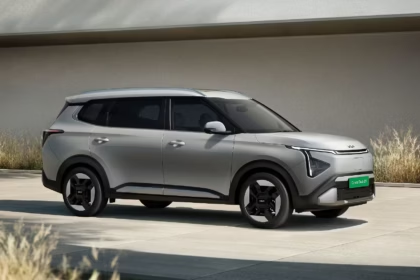
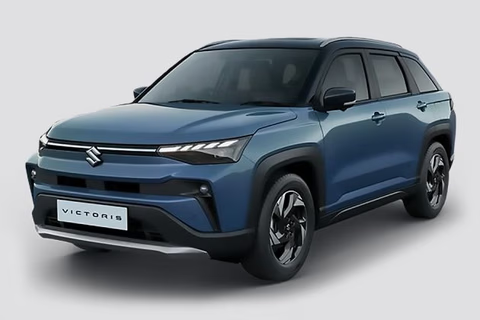
Maruti Suzuki is preparing to launch a series of electric vehicles suited for Indian consumers, starting with the Maruti e-Vitara, a mass-market family EV designed for practicality, efficiency, and everyday usability. The company plans to make EV ownership much more accessible while retaining reliability and quality that Indian buyers can trust.
Maruti e-Vitara: Mass-market family EV with practical range and features;
- Designed for Indian families, it accommodates 4–5 passengers.
- Practical driving range of approximately 300–350 km on a single charge.
- Equipped with modern infotainment, safety features, and climate control, suitable for urban and highway driving.
- Compact dimensions for easy city maneuvering, coupled with SUV-like ride comfort.
Other planned EVs in compact, SUV, and hatchback segments:
- Compact EVs: Affordable, city-friendly cars targeted at first-time EV buyers.
- Hatchbacks: Budget-friendly models intended for a daily commute.
- SUVs: Premium electric options offering greater range, spacious interiors, and advanced features.
- Phased rollout over 2025-2030, covering multiple price brackets and consumer needs.
Re-orient towards affordability, without sacrificing quality and safety:
- EVs at competitive prices with petrol/diesel versions to attract middle-class consumers.
- Retention of Maruti Suzuki’s reputation for being durable and of low maintenance.
- Safety features such as ABS, airbags, and crashworthy structures are standard across all models.
- Battery management and vehicle systems optimized for long-term reliability.
Highlighting Indian-specific design considerations and battery efficiency:
- Batteries that are built to handle the extreme Indian climate: the heat, humidity, and all types of monsoon conditions.
- Interior layouts optimized for family comforts and storage needs.
- Charging and battery systems compatible with India’s emerging EV infrastructure.
- Use of lightweight materials ranges without raising the costs.
Challenges & Considerations
While Maruti Suzuki is ambitious in its EV plans, several challenges must be overcome to ensure successful implementation. Each aspect-from infrastructure hurdles, grid management, and competition in the market-requires proper planning and cooperation.
Land availability and local permissions for charging stations:
- Acquiring the best sites in city and highway locations is often slow work.
- Requires collaboration with municipal authorities and must conform to zoning laws.
- Balancing land acquisition cost against accessibility to EV users.
- Navigating environmental and safety approvals for large-scale deployment.
Reduce peak load on local electricity grids:
- High concentration of fast-charging stations may strain local power infrastructure.
- Entails coordination with state electricity boards and integration of renewable energies.
- Employ innovative charging solutions to manage peak demand.
- This may lead to a need for energy storage systems at charging hubs to stabilize supply.
| Competitor | Key Strengths | Maruti’s Counter Strategy |
| Tata Motors | Established EV models (Nexon EV, Tigor EV), strong brand presence | Mass-market affordability, extensive service network |
| MG Motors | Premium EVs with advanced features (ZS EV) | Focus on family-friendly, cost-efficient EVs for India |
| Hyundai | Kona EV and Ioniq series, modern tech integration | Localized EV solutions and charging infrastructure expansion |
| EV Startups | Agile, innovative offerings, niche market targeting | Reliability, brand trust, and nationwide reach, leveraging decades of ICE experience |
Charging point maintenance and uptime targets: (>95%)
- Ensuring minimum downtime through preventive maintenance and remote monitoring.
- Training staff for quick response to technical and operational problems.
- Integration of digital platforms for real-time monitoring, customer support, and feedback.
- Ensuring consistent charging speed, safety, and reliability irrespective of location.
Impact on the Indian EV Ecosystem
In sum, Maruti Suzuki’s EV initiatives are bound to send ripples across India’s automotive and energy landscape. Emphasizing affordability, accessibility, and dependability will accelerate adoption and build confidence among all constituencies: consumers, businesses, and policymakers.
Increased consumer confidence in electric mobility.
- Availability of trusted Maruti Suzuki EV models encourages first-time buyers.
- A nationwide charging network reduces range anxiety while simultaneously enhancing convenience.
- The proven reliability of Maruti vehicles reassures consumers about maintainability and resale value.
- Educational campaigns and awareness programs to promote EV benefits.
Boost to local manufacturing and supply chain development:
- Investments in domestic battery production and the manufacturing of EV components.
- Encouraging innovation among Indian suppliers and developing EV-related capabilities.
- Employment generation in EV assembly, battery manufacturing, and charging infrastructure.
- Strengthening Make in India initiatives and reducing dependence on imports.
Support for net-zero and climate goals of India:
- Reduced CO₂ emissions through the adoption of electric mobility in urban and intercity travel.
- Alignment with government targets for sustainable transport and renewable energy.
- Contribution to cleaner air and lower urban pollution levels.
- Promotion of energy-efficient mobility solutions integrated with smart grids.
Potential to reshape urban mobility and reduce dependence on fossil fuels:
- Encouraging a shift from petrol/diesel to EVs in cities.
- Integrating with shared mobility, fleet operators, and public transport electrification.
- Creating innovative, sustainable urban transportation ecosystems at reduced operational costs.
Conclusion
Maruti Suzuki is uniquely positioned to transform the electric vehicle landscape in India. While focusing on introducing reliable, affordable EVs, it will also build an extensive charging infrastructure, making electric mobility mainstream by 2030. The company is all about quality, accessibility, and customer trust, which has kept it in the number one position and which will continue to define the roadmap for sustainable mobility in India.
FAQs Section
- What is Maruti Suzuki’s first EV in India?
The e-Vitara, a family-friendly SUV tuned for urban and highway driving, is expected to become Maruti Suzuki’s very first mass-market EV.
- Will Maruti’s EVs support fast charging?
Yes, Maruti EVs will be compatible with fast-charging stations, allowing around 80% charge in 30–45 minutes.
- What are the expected launch dates for the upcoming models?
The rollout of Maruti EVs in compact cars, hatchbacks, and SUVs would be phased over 2025–2030, with the e-Vitara among the first launches.
- What would be the estimated range of Maruti’s EVs?
Maruti’s electric vehicles are likely to return a real-world driving range of around 300-350 km per charge, enough for daily intra-city runs as well as inter-city driving.