Introduction
The Mahindra XEV 9S and Tata Sierra are amongst the most talked-about upcoming SUVs in India, not only because they come from two of the biggest homegrown brands but also because they represent two very different directions in the Indian automotive landscape.
While the XEV 9S embodies a fully electric future, long-range capability, and a tech-rich 7-seater cabin, Sierra brings nostalgia, rugged SUV character, and modern internal combustion engines back into mainstream midsize motoring. Together, they create an unparalleled EV vs. ICE battle that is setting new buyer expectations in the year 2025.
What are the reasons they are currently in the limelight?
- Both SUVs are major strategic launches for their respective companies in 2025 and target high-growth segments.
- It highlights two contrasting design philosophies catering to entirely different kinds of Indian buyers: futuristic electric mobility versus the modern reinterpretation of an iconic SUV.
- Every one of them promises premium interiors, new-age features, and a strong brand heritage in this segment, something that has already piqued buyers’ curiosity well before the launch.
- Auto enthusiasts are keeping a close eye on this comparison, as it underscores the transition phase India is going through: a tussle between EV adoption and conventional, performance-driven SUVs.
- Their pricing strategies and segment positioning may well determine the shape of the Indian family SUV space over the next three years.
XEV 9S: Mahindra’s new 7-seater electric SUV to ‘wow’ with range, tech, and family usability by: Bhaugav V Shah
- Built as a dedicated long-range electric SUV with numerous battery options to fit long family road trips.
- It features three rows of seating, making it one of the few premium electric 7-seater options in the country.
- This car features a technology-laden interior, with several digital displays, AI-powered interfaces, and advanced connectivity options.
- Equipped with Level-2+ ADAS, this all-new model comes with additional safety and semi-autonomous driving features.
- Prioritizes family comfort with a spacious cabin layout, a flat floor, premium upholstery, and EV-specific storage solutions, such as a frunk.
- Positioned as Mahindra’s flagship electric model, the car signals the brand’s drive to become a major EV-focused manufacturer.
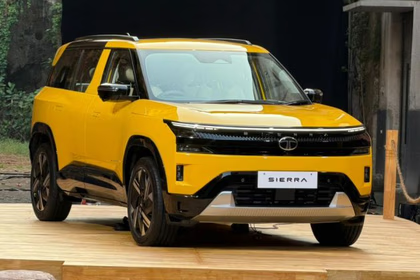
Tata Sierra: Tata’s revived nameplate in the midsize SUV segment with modern features and ICE powertrains
- It reimagines the legendary Sierra nameplate in a modern form while retaining its distinctive SUV silhouette.
- Powered by efficient 1.5-litre petrol and diesel engines, which may be more appealing to buyers not ready to abandon traditional powertrains just yet.
- It slots into the mid-size SUV category, competing with several high-selling models, but with a very premium feature list.
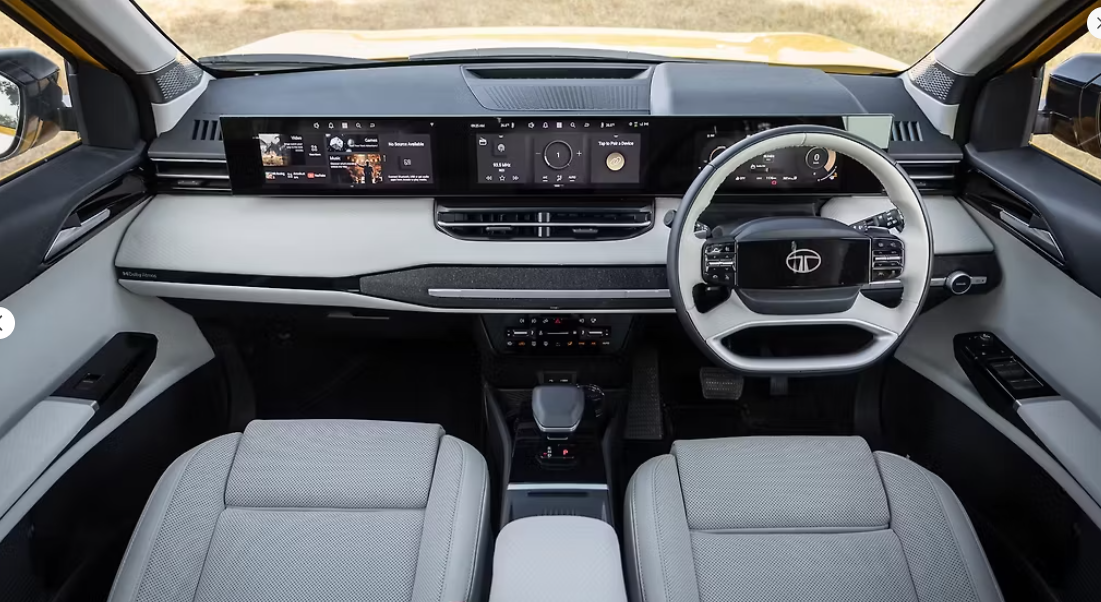
- Comes with advanced features such as triple screens, premium comfort features, voice-assist tech, and a contemporary cabin layout.
- Much appeal to the buyers who favour rugged design, reliable ICE engines, and the familiarity of conventional refuelling.
- It represents Tata’s attempt to blend nostalgia with modern practicality, putting it in a special position in the increasingly crowded SUV market.
Set the scene for the comparison to be drawn – EV versus the traditional choice of the petrol/diesel system.
- Outlines the biggest buying dilemma of 2025: to switch to electric or stick with proven petrol/diesel setups.
- The XEV 9S is about future-ready mobility, zero tailpipe emissions, lower running costs, and advanced technology.
- It is targeted at buyers who value the long-distance convenience, fast refuelling, and robust nature of the ICE engine.
Segment & Positioning
The Mahindra XEV 9S and Tata Sierra belong to two different segments. Mahindra positions the XEV 9S as a premium, future-ready electric SUV with modern comforts for 2025 buyers.
XEV 9S: All-electric three-row SUV targeted toward families and EV adopters:
- It positions itself as a more premium electric alternative to traditional 7-seater SUVs, offering families an opportunity to transition to a full EV ecosystem.
- The three-row seating layout is targeted at larger households that want versatility in seating without sacrificing much luggage area.
- Appeals strongly to first-time EV adopters who want long range, fast charging capability, and advanced tech experiences.
- The company uses this model to consolidate its position in the high-end EV SUV category amidst rival products from international EV makers.
- It appeals to buyers who value low running costs, a modern interior, a digital interface, and sustainable mobility.
- It’s strategically positioned as a flagship EV, leading the charge with Mahindra’s future design language and battery tech.
 Sierra: mid-size SUV, nestled between entry-level and premium mainstream SUVs.
- Aims at the high-demand mid-size SUV segment, targeting buyers who upgrade from compact SUVs or hatchbacks.
- Fills the sweet spot between affordability and premium feel; it’s above entry SUVs in terms of features yet below full-size premium models in pricing.
- Designed for customers who want a balanced ICE driving experience, it features refined petrol and diesel engine options.
- Positioned as a lifestyle SUV, it has the crowd.
- Optimized to appeal to urban families wanting practicality, comfort, and solid brand reliability without having to bear the higher pricing of larger SUVs.
- Acts as Tata’s strategic model that bolsters its presence in the mainstream SUV space, complementing models such as the Harrier and Safari by sitting just below them in the segment hierarchy.
 Pricing & Variants
The Mahindra XEV 9S and Tata Sierra differ significantly, reflecting the markets and customer segments they target. While Mahindra XEV 9S positions itself as an upscale offering, some variant models range above 19.9 lakh, and several models offer extra-advantageous features. Its pricing strategy focuses on very advanced EV tech and larger batteries in a 7-seat configuration. But Tata Sierra enters the mainstream SUV market with a pricing structure starting at 11.5 lakh, rising with additional key features, engine, and transmission options. Just looking at this price difference clearly reveals that these two cars target completely different market segments.
XEV 9S: Begins at around 19.9 lakhs and goes up to hi-spec models
- Catering to the mid-to-premium EV SUV market, based on its sophisticated EV components and three-row configuration.
- It comes with various battery options, and as the range increases, so does the price.
- Variants with high specifications include Level-2+ ADAS, Panoramic Displays, AI Technology, Fast Charging, and Interior Materials.
- Attracts customers interested in emission-free mobility solutions and willing to invest in long-term savings.
- The price ladder is designed to rival emerging EV competitors and global electric options available in India.
- It serves as Mahindra’s flagship EV offering, implying a price premium.
Sierra: More mainstream SUV pricing, Price kicking about Rs. 11.5 lakhs and upwards based on variants/options
- Also enters the competition in the mid-size SUVs’ price segment.
- The lower variants are expected to have a manual transmission, smaller infotainment systems, and safety features as standard.
- Higher variants will get turbo-petrol/diesel engines, automatic transmission, three screens, premium interiors, and the latest ADAS features.
- The pricing strategy aims to attract people migrating from compact SUVs who haven’t yet entered the full-size SUV market.
- Offers flexibility in purchasing variants based on features and price, making it suitable for urban and semi-urban regions.
- It would be competing with mainstream SUVs like Creta, Seltos, Elevate, and Grand Vitara, but would have a differentiated identity because it would be resurrecting an old brand.
Powertrain & Performance
The Mahindra XEV 9S and Tata Sierra offer totally different performance experiences. The reason for these differing performance experiences offered by these cars is that they have totally different engines. While the Mahindra XEV 9S is an all-electric SUV, it emphasizes rapid acceleration and a smooth and quiet driving experience. On the other hand, Tata Sierra uses conventional internal combustion engines, providing drivers with the familiar, well-known rapid and smooth acceleration delivered by turbo-petrol.
XEV 9S: Electric motor with ample power and rapid torque response
- The electric power train ensures an immediate response to acceleration, with rapid acceleration from rest.
- It produces a higher peak torque than most midsize SUV ICEs.
- Provides a smooth, vibration-free drive, particularly in urban driving.
- It is perfect for family cars, especially for parents who want a smooth, noise-free driving experience.
Various battery options available (for instance, 59, 70, and 79 kWh with differing ranges)
- Battery options provide opportunities based on daily use and budget.
- A larger battery pack will provide a greater range, capable of intercity travel.
- Smaller packs make it easier to get a better price without sacrificing city range.
- Supports fast charging functions, useful for people with tight travel schedules.
Smooth acceleration and faster speed for EVs
- Provides a smooth acceleration graph with no delay or vibration.
- Keeps stable at high speed thanks to its low center of gravity and superior battery position.
- Able to achieve a competitive maximum speed comparable with that of luxury EV SUVs.
- Provides selectable drive modes (e.g., Eco, Normal, Sport) for adaptive performance based on driving habits.
Tata Sierra: Conventional Internal Combustion Engines, eg, 1.5 Litre Turbo-Petrol/Diesel Engines
- “Turbo-petrol engine” provides very strong mid-range power. It’s perfect for overtaking and for drivers.
- The diesel engine assures very good torque and fuel economy, attracting long-distance drivers.
- Engines are tuned for ruggedness and reliability, as suited to Indian road conditions.
- Offers a more exciting engine sound and response for customers who want a mechanical experience.
Conventional Gearbox Options (Manual/ Automatic)
- A manual transmission allows better gear changes and thus better control, especially on busy roadways and in hilly areas.
- Automatic transmission makes city driving more comfortable. It reduces driver fatigue on daily commutes.
- Gear ratios are optimized for acceleration and fuel mileage.
- Offers customers a choice based on their driving behaviour and road conditions.
Balanced city and highway driving performance
- The engine and suspension configuration have been properly set to provide a smooth ride.
- Offers reliable performance, making it perfect for daily commutes and family outings.
- Highway cruising is smooth, and there are ample sources of power, mainly in the turbo trims.
Range / Fuel Economy
The Mahindra XEV 9S and Tata Sierra take two completely different approaches. As a pure electric SUV, the XEV 9S offers impressive long-range capability, with hundreds of kilometres depending on the selected battery pack and driving conditions.
The EV architecture ensures much lower operating costs and consistent performance, unaffected by fluctuations in fuel prices. On the other hand, the Tata Sierra, powered by petrol and diesel engines, focuses on competitive fuel economy within the mid-size SUV segment. The model targets customers who still prefer the convenience of traditional refuelling, combined with the predictability of long-distance travel independent of charging infrastructure.
XEV 9S – Long EV range in a single charge can cover several hundred km:
- Offering multiple battery options tuned for urban, mixed, and highway driving styles.
- The larger 70 kWh+ battery packs are expected to deliver extended highway range, perfect for long family road trips.
- The efficiency of EVs remains roughly the same in city conditions because regenerative braking also recovers energy.
- Running cost per kilometre is much lower than that of petrol or diesel SUVs, making it ideal for high-mileage users.
- The range varies depending on driving mode, temperature, speed, and load, but it remains competitive in its segment.
- Allows convenient overnight home charging, reducing reliance on public charging stations for daily use.
Sierra: Competitive fuel efficiency for petrol/diesel engines
- The 1.5-litre petrol engine delivers decent mileage for city commuting and can thus be a viable option for people with mixed usage.
- The diesel engine delivers superior fuel economy, especially on highways, where long-distance efficiency matters.
Exterior Design
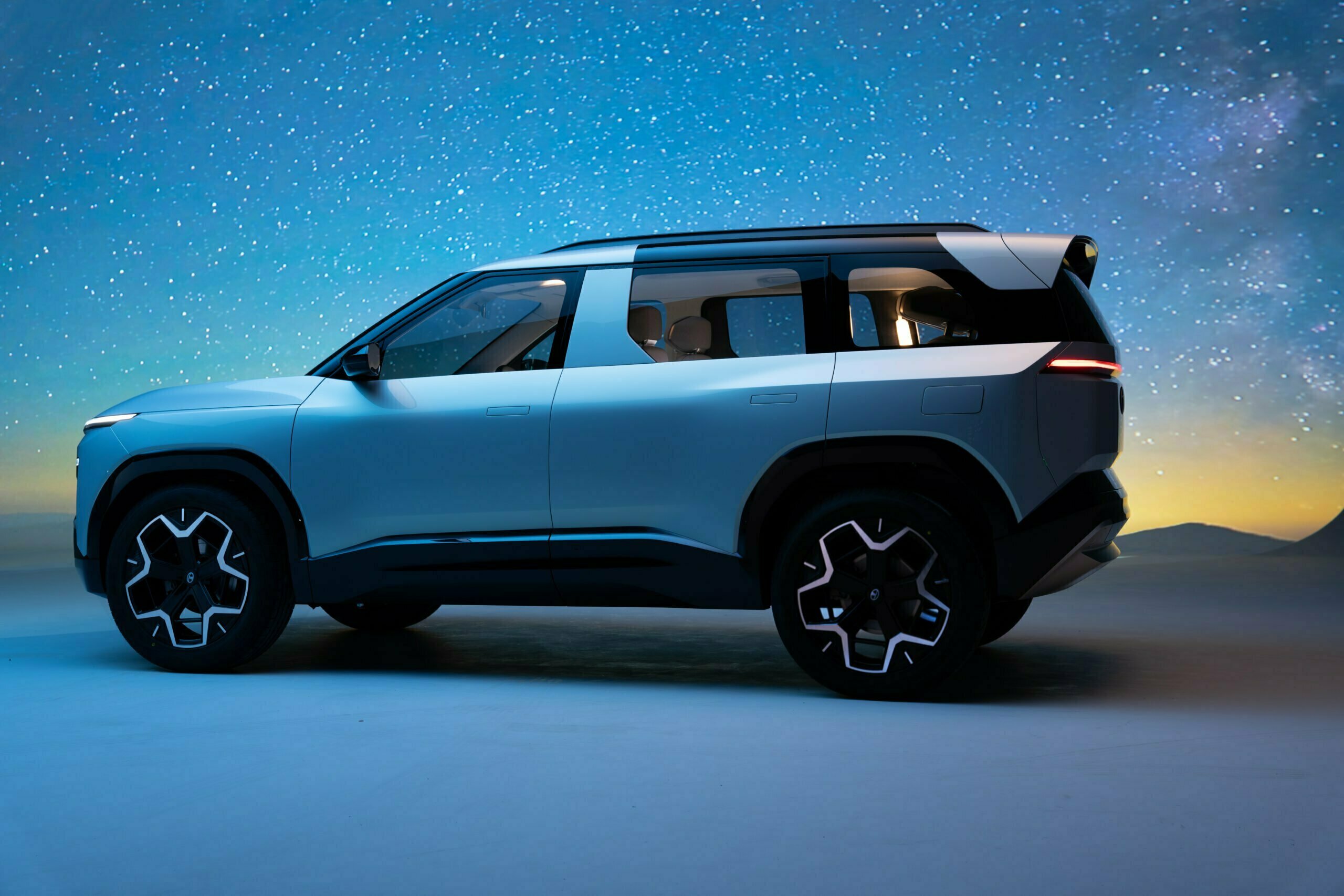
The Mahindra XEV 9S and Tata Sierra have two drastically different designs to appeal to today’s SUV market. The Mahindra XEV 9S sports an avant-garde EV-centric design. The Tata Sierra, on the other hand, adopts an aggressive stance.
XEV 9S — Exterior Features
- Clean and flush graphics with fewer cuts and creases for better aerodynamics and a more modern look.
- Full-LED Headlamp Setup: Slim DRLs extending across the fascia, linked light sources, and projector LED lamps give it a luxury EV look.
- Aerodynamic Profile: Smooth panels, low-drag wheel designs, and a tapered roofline.
- Closed-Off Front Grille: EV dedicated front end with a closed grille indicating zero tailpipe emissions and an upgraded cooling system.
- Flush Door Handles: Improves airflow and contributes significantly to the sleek, futuristic look.
- Large Alloy Wheels (17-19 inch range): Stylish and aero-optimized wheel designs for aesthetics as well as efficiency.
- Panoramic Design Language: Long wheelbase and elongated shape with an emphasis on its 7-seat capacity.
Tata Sierra – Major Exterior Features:
- Independently Wired Headlamps: Tata Sierra Signature, Sierra Silhouette Sports a classic variant of the iconic wraparound rear quarter glass design.
- Tata’s Bold SUV Stance: Upright muscular build with broad shoulders and strong character lines.
- Heritage and Modernity Mix: It pays tribute to the traditional Sierra while incorporating modern presence, which should be evident in 2025 SUVs.
Interior & Features
The Mahindra XEV 9S and Tata Sierra have tech-laden, rich interiors, but with different strategies. The Mahindra XEV 9S adopts a futuristic EV-centric design, with a minimalist dashboard and intelligent storage enabled by the EV platform. Its three-row configuration makes it an excellent option for larger families who prioritize space and tech.
The Tata Sierra, on the other hand, maintains strong roots in comfort and functionality, delivering superior materials and feature sets suited to mainstream SUV buyers who still favour a traditional 5-seat configuration. Both models are about modernity but focus on EV advancements and harmony, with the Tata Sierra more focused on a traditional user experience and comfort.
XEV 9S — Interior and Features
- Tech-Focused Triple-Screen Cabin Layout: Featuring a digital instrument cluster, a central display for infotainment, and a secondary screen for passenger or vehicle functions.
- Advanced Infotainment System: Wireless Android Auto/Apple CarPlay, internet, and cloud services.
- Panoramic Glass Roof: Enhances cabin openness and creates an upscale ambiance. It makes the interior appear roomier.
- 7-Seat Roomy: It comes equipped with three rows of seating and ample head- and legroom.
- EV-Specific Storage Benefits: Includes a front trunk (frunk) for additional cargo space and a large rear boot.
- Minimalistic and Modern Dashboard: A clean design with fewer buttons and an accent on digital control, and a futuristic look.
- Ambient Lighting and Luxury Upholstery: Adds elegance and enhances nighttime driving ambiance.
- Multiple Charging Points + Wireless Charging Pad: Ensures all passenger devices remain powered on throughout the trip.
 Tata Sierra — Interior & Features
- Tata Sierra Features Triple Screen feature: PREMI. It contains an instrument display, a central infotainment screen, and a secondary functions screen for media or comfort.
- Handy Room Amenities: Ventilated front seats, dual-zone automatic climate control, and better seat materials.
- 5-Seat Layout: Practical, Generous seating capacity for all passengers, with broad, cushy pillows for daily drives and weekend getaways.
- Center Console Designed for Utility: It is essential for Smart storage cubbies, cup holders, and ergonomic control locations.
- Infotainment Experience: and an Easy-to-use interface meant for mainstream SUV buyers who value simplicity over technological sophistication.
- Premium Sound System (dependent on variant): Provides immersive audio, perfectly tuned for optimal cabin acoustics.
- Soft Touch Dashboard and Door Panels: They enhance cabin ambiance and raise the level of sophistication.
- Multiple USB Ports + Fast Charging Options: It keeps devices charged for all passengers without compromise.
 Safety & Driver Assistance
Both the Mahindra XEV 9S and the Tata Sierra emphasize modern safety features, but with slightly different priorities. The Mahindra XEV 9S, as a next-gen electric SUV, will be more inclined towards an advanced set of safety features based on an ADAS system, with a focus on Level 2+ autonomous driving capabilities and advanced sensor fusion, incorporating the latest technologies to assist drivers.
The Tata Sierra will provide a comprehensive safety solution, characteristic of Tata’s impressive safety performance in crash tests, and will feature a robust safety package with an emphasis on Level 2 ADAS and a strong structural design.
XEV 9S -Safety&ADAS Highlights
- All XEV 9S cars incorporate a Level 2+ ADAS that offers adaptive cruise control, lane-keep assist, lane centring, traffic jam assist, and smart braking systems.
- High-Resolution Camera + RADAR + Ultrasonic Sensor Fusion: Ensures reliable detection of cars, pedestrians, lane markings, and obstacles even in inclement weather.
- Autonomous Emergency Braking System: It has automatic brakes to prevent or reduce impact in the event of a collision.
- ESP: Improves control in slippery and sudden maneuvering conditions.
- Traction Control and Hill-Hold Assist: Prevent wheel slip and enhance safety and ease of driving up hills.
- EVs – Safety Protocols: High voltage battery protection, thermal management systems, and crash-safe battery locations.
Tata Sierra – Key Safety and Special Features
- Level-2 ADAS Package: It includes safety features like forward collision warning and AEB.
- Strong Body Structure: Tata’s Global NCAP legacy.
- Designed on a strong structure proven for excellent crash-test results.
- Multiple Airbags (6 on higher trims): Provides occupant safety against front and side collisions.
- 360° Camera Setup: Assists with safe parking, tight cornering, and town driving.
- Rear and Front Parking Sensors: Improve low-speed awareness for reversing and parallel parking. ESC, Controllo di Trazione e Mitigazione, provides stability in sudden turns or in an emergency.
- Hill Descent Control (for certain variants): Helps with controlled descent on uneven or sloping terrain.
- ISOFIX Child Seat Anchors improve: child safety for family buyers.
- Tyre Pressure Monitoring System (TPMS): Alerts the driver to a rapid or potentially hazardous pressure drop.
Comfort, Practicality & Space
The Mahindra XEV 9S and Tata Sierra offer two distinctly different approaches to passenger comfort and cabin functionality. While the Mahindra XEV 9S, based on its dedicated EV platform, boasts optimal use of space with a flat floor and flexible seating and storage options, making it perfect for a large family and road trips. It concentrates on delivering world-class comfort with all necessary mod cons.
The Tata Sierra, on the other hand, focuses on helping people carry out daily activities with ease, with its welcoming cabin, intelligent design, carefully shaped seats, and ample storage space. Its features are carefully designed for ease of use, ensuring that everyone on board leads a productive and enjoyable life.
XEV 9S – ‘Comfort, Space & Practicality’
- Large Cabin with Flexible 3-Row Seating: Provides various seating configurations, making it convenient for family cars that need additional space for adults, children, and/or cargo.
- Fold-Flat Rear Seats for Maximum Cargo Space: When folding the second- and third-row seats, the boot space increases considerably, allowing travel carriers, camping equipment.
Printable Materials: Refined ambiance.
- Ventilated Seats (Front) and Multi-Zone Climate Control: It assists in maintaining comfort while on a long drive on a sunny summer day, and also ensures that there are personalized temperature zones
- Panoramic Sun: It enhances a sense of openness and spaciousness in the passenger compartment.
- Multiple USB-C Ports + Wireless Charging: Makes it more convenient for passengers who use gadgets and intelligent devices.
- Smart Storage Solutions: Comes with deep door bins, under-floor storage, and seat pockets.
Tata Sierra: Comfort, Space & Practicality
- Practical Seating Arrangement for All Passengers: Public transport. The seats, with good cushioning and an ergonomic design, provide a comfortable journey.
- Balanced Boot Space for Daily and Weekend Use: Provides enough cargo room for a family while keeping it easy to get in and out.
- Cabin Layout – Practical Considerations: It emphasizes user friendliness, with logically positioned controls, large door pockets, and an uncluttered dashboard.
- Rear AC Vents and Adjustable Headrests: To provide more comfort for passengers in the back.
- Optimized Feature Set for Usefulness: As previously comprises wireless Android Auto/CarPlay, remote entry, start, and useful storage cubbies.
- Harmonious Ride Quality: It has a suspension tuned for city roads and some patches of light off-roading.
- Sound Insulation Upgrades: Lower cabin noise levels improve comfort, particularly at highway speeds.
Running Costs & Ownership
As far as running costs and overall experience are concerned, there are many differences between the Mahindra XEV 9S and the Tata Sierra. Since the Mahindra XEV 9S is an electric SUV, it has a remarkably low cost per kilometre and requires less maintenance, as there are fewer components than in an ICE engine.
Moreover, it can be charged at home with ease. On the other hand, Tata Sierra offers a familiar, easy refuelling experience because it can be fuelled with petrol or diesel, and it also requires regular maintenance, which some customers prefer. Overall, the Mahindra XEV 9S leads the competition because it has low running costs, while the Tata Sierra is preferred by people who value easy refuelling and maintenance.
XEV 9S – Running Costs & Ownership
- Cost per Kilometre: Extremely Low. Electricity costs are much lower than petrol and diesel. It reduces daily operating costs by up to 70%.
- Minimal Mechanical Maintenance: No changes to engine oil are required, as there are fewer moving components than in traditional ICE cars.
- Home Charging Convenience: Owners can charge their cars at night with either a standard or a rapid charger at home, eliminating the need to visit charging stations regularly.
- Lower Service Intervals: Components specific to EVs have fewer maintenance intervals than those in traditional cars.
- Regenerative braking helps reduce: components will have a longer lifespan, thus contributing to lower maintenance costs.
- Potential Government Incentives: Subsidies, road taxes, or state benefits for EVs could further augment the cost-effectiveness.
- Long Battery Warranty: Commonly provided for 7-8 years, thereby offering peace of mind and guaranteed consistency.
Tata Sierra – Running Costs and Ownership
- Cost of Ownership: Rs 1.20 lakh per Convenient Fuel Refilling.
- Petrol and diesel fueling stations are geographically dispersed, thus eliminating range anxiety and reliance on charging infrastructure.
- Large Tata Service Network: Maintenance centers are easily accessible in urban, semi-urban, and rural areas.
- Cost-Effective, Predictable: Maintenance. The conventional engine, gearbox, and mechanics provide a straightforward operating pattern for most customers.
- Lower Upfront Cost Compared To EVs: The price at which it can be bought initially is lower. This might offset some extra costs associated with operating it.
- Easy Long-Distance Travel: Not necessary to plan routes around charging stations–very good on highways and rural areas.
- Cost-Effective Spare Parts and Service Packages: Tata’s extensive spare parts chain keeps costs competitive.
- User-Friendly Ownership Experience: Designed for buyers who prefer conventional refuelling methods, common service schedules, and maintenance procedures.
Who Should Buy Which?
Whether it should be a Tata Sierra or a Mahindra XEV 9S would depend solely on the kind of buyer you are. The XEV 9S will appeal to people who want an eco-friendly and modern electric lifestyle. Families who want a car that goes an extra mile with its high-end tech, advanced safety features, and refreshingly low running costs will no doubt be drawn to it. But on the flip side, there are people, perhaps like myself, who want a tried-and-tested option with a gasoline or diesel engine. And then there’s an entry price that’s a heck of a lot lower than its competitors’.
Quick Comparison Table
| Powertrain | Electric (multiple battery options) | Petrol/Diesel engines |
| Seating | 7-seater | 5-seater |
| Range / Efficiency | High electric range | Efficient fuel economy |
| Technology | Advanced tech first for EV segment | Feature-rich mainstream SUV |
| Safety | Level-2+ ADAS, strong safety suite | Level-2 ADAS, good safety kit |
| Price | Premium EV pricing | More affordable ICE SUV |
| Practicality | EV advantages + flexible space | Practical for everyday use |
FAQs
Q1: Which vehicle has more interior space?
- The XEV 9S offers a much larger cabin with three-row seating, making it ideal for larger families.
- The Sierra is a pretty spacious 5-seater, indeed performing well for everyday SUV needs, but not as roomy as the XEV 9S.
Q2: Does charging infrastructure pose an issue for XEV 9S?
- Charging infrastructure is growing rapidly in India, especially in urban areas.
- However, EV owners might need to plan charging stops for long highway or remote trips, unlike the Sierra, which can refuel instantly anywhere.
Q3: Which has better tech features?
The XEV 9S emphasizes tech with EV-focused displays, connected systems, ADAS safety, and modern digital interfaces. The Sierra also provides a robust feature set, including triple displays with premium amenities, but within a traditional ICE platform.
Q4: How much do they cost to run?
The XEV 9S has ultra-low running costs due to lower electricity costs and fewer mechanical maintenance requirements. It also requires periodic servicing and fuel expenses, making the Sierra comparatively costlier in the long term.