Introduction
Toyota is all set to create a significant splash in India’s rapidly growing electric car space—the first mainstream compact electric SUV for the country. Noting India’s EV shift is accelerating among competitors like Tata, Mahindra, Hyundai, and MG, Toyota will finally enter the segment with a product designed for practical urban use, strong real-world range, and comfort in daily driving. In this way, the Toyota Urban Cruiser EV represents a strategic push by Toyota to make a reliable, affordable, user-friendly electric SUV available for Indian families, daily commuters, and first-time electric vehicle buyers.
Why the Urban Cruiser EV is generating buzz in India
- Mainstream market EV debut from Toyota: Buyers in India have been waiting for the first serious electric model from Toyota, and now the Urban Cruiser EV finally signals that shift.
- Based on a tried-and-tested, localized platform: Co-developed with Suzuki, ensuring lower manufacturing costs, translating into competitive pricing for Indian buyers.
- Expected long driving range: with battery options of ~50–60 kWh, the EV promises a real-world range of 350–450 km—ideal for City + occasional highway trips.
- Tech-loaded with modern features, dual displays, ADAS, wireless connectivity, and a premium interior, this is more advanced compared to the previous generation of Toyota compact SUVs.
- Strong brand trust factor: this EV’s promise of the same Toyota reliability, low maintenance, and long life really appeals to pragmatic buyers.
- Can change the pace in the compact EV SUV segment: It comes at a great time, just when buyers are desiring affordable EVs with a big range and everyday usability.
Positioning – a mass-market, feature-rich, city-friendly electric SUV.
- Mass-market EVs aim for affordability, positioning them below premium electric vehicles.
- The Urban Cruiser EV is targeted towards first-time EV adopters and families upgrading from a petrol/diesel compact SUV line-up.
- City-friendly compact dimensions: designed for crowded urban environments, easy parking, and smooth maneuverability in traffic-heavy cities.
- A feature-loaded package catering to modern needs: ADAS, 360° camera, digital displays, and connected tech make it one of Toyota’s most updated compact SUVs to date.
- Balanced performance over aggression, tuned for comfort and low running costs rather than sporty acceleration, perfectly fine for daily commuting.
- Practicality at its core: From cabin space to charging convenience, the SUV is engineered for real-world usability rather than headline-grabbers.
- This model aims to be the “reliable EV for Indian households”: Toyota wants this model to be first in the minds of families who are more concerned with safety, durability, and sustained performance over the years of ownership.
Latest Updates: What’s New in 2025
2025 has been a big year for the Toyota Urban Cruiser EV-the model has finally moved from concept to near-production reality, with global reveals, a public showcase in India, and detailed specifications being made public.
What had started as a somewhat vague concept under the EV push has crystallized into a well-defined electric SUV offering: the vehicle now comes with clearly defined battery, motor, and feature options; clearly visible exterior design cues that show a modern, urban-SUV look; and a clarified launch plan for India.
This new clarity has turned the Urban Cruiser EV from a hypothetical project into a real-world product that buyers and EV-watchers can evaluate, which is why the 2025 updates are so important for anyone looking to determine whether the hype is justified.
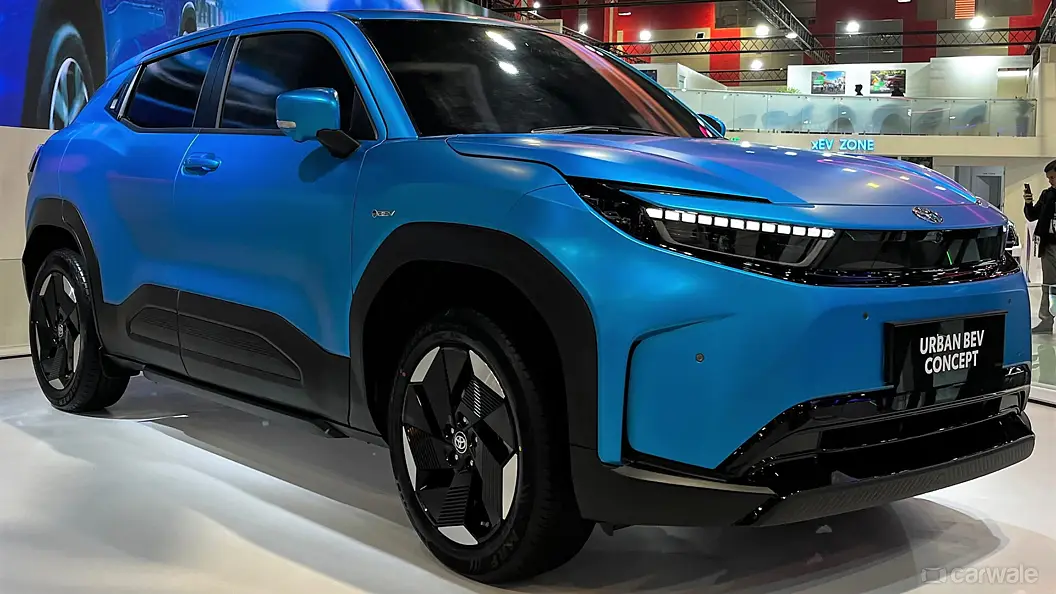 Exterior design: Sharper front, LED lighting, and an aerodynamic body
- The refreshed front fascia of the Urban Cruiser EV features a modern shape: slim LED headlamps, a grille-less or closed grille design, and vertical/fascia styling that signals its EV identity.
- The body’s design is geared toward greater aerodynamic efficiency, with smoother curves and lines that depart from traditional boxy-SUV looks, giving it a more contemporary, urban-ready profile.
- Dimensions are still compact, making it easier for those urban buyers who want SUV practicality without excessive size.
- With new alloy wheel designs and exterior trim elements, it feels rather premium-ish compared to older compact SUVs, making it one of the more interesting entry-level rides out there.
Interior upgrades & features: dual screens, wireless connectivity, ADAS, premium materials
- Dual screens now grace the cabin design: a digital instrument cluster about 10.1″ and a central infotainment touchscreen about 10.25″ give it a modern, connected EV feel.
- Connectivity features like wireless Apple CarPlay/Android Auto, most likely OTA-ready systems, and expected smart-car integrations align it with the global EV cabin standards.
- Comfort and convenience features reportedly include a floating centre console with shift-by-wire and electronic parking brake, and intelligent cabin layout.
- Other comforts reportedly coming: automatic climate control, possibly a panoramic sunroof/fixed-glass roof, sliding/reclining rear seats, and flexible rear seat folding (to better increase boot or passenger room).
Expected India launch timeline
- The Urban Cruiser EV made its debut at 2025 industry events, including local expos, a sure sign that its India debut is being actively planned.
- Industry speculation points to a launch by the end of 2025. Some reports tie it to festival-season rollouts or year-end introductions.
- Manufacturing is likely to be at a local facility, which will help keep costs in check and support a competitive India launch plan.
- Bookings are likely to start a few months before the launch, with priority given to major metro cities, followed by a pan-India rollout once the supply and distribution lines stabilize.
Packs of batteries available and expected range figures
- It will come in a smaller 49 kWh battery pack and a larger 61 kWh pack, both with LFP-cell type batteries.
- For the 49 kWh version, we can expect a front-wheel-drive setup, while the 61 kWh pack likely brings a more powerful motor and, at least, an all-wheel-drive option in global specifications.
- The estimated real-world range is about ≈ 400 km for the 49 kWh version and ≈ 490 km or more for the 61 kWh version (on full charge, under favourable conditions).
- The expected power output will be in the ballpark of 140-175 hp, depending on the battery/trim variant, enough for smooth, responsive driving in the city and on the highway without aggressive “sports-EV” performance.
- Charging expectations include support for a standard home charger and likely DC fast charging for quicker long-distance readiness, though exact Indian-spec charging times have yet to be confirmed.
Global unveil + India-specific configuration changes
- The Urban Cruiser EV officially made its world debut on a shared platform with its “sibling” EV SUV, and the car is reportedly production-ready for multiple markets, including India.
- For India, the car is expected to follow local preferences: FWD may be standard in lower-cost variants, while AWD may or may not be offered given Indian road and cost dynamics.
- Some may remain global-spec features, such as a sunroof/fixed-glass roof, ambient lighting, and premium upholstery, with regional adjustments based on demand, regulations, and cost/feature balancing.
- Local assembly means better parts availability and easier service/maintenance, both of which can enhance the ownership experience in the long run, compared to completely imported EVs.
- India-spec pricing is expected to be tuned for better affordability, making the Urban Cruiser EV competitive in the growing compact/mid-SUV EV space, especially against rivals from both legacy manufacturers and EV-first brands.
Design & Exterior Highlights
The Toyota Urban Cruiser EV is a modern electric identity with a confident, upright stance that feels urban-friendly and premium. Its bold proportions, clean surfacing, and aerodynamic contours immediately signal its futuristic yet practical road presence. Unlike older compact SUVs, where heavy lines and bulky shapes have dominated the design philosophy, the Urban Cruiser EV offers a modern interpretation through smoother edges, slimmer lighting elements, and distinctive styling cues that emerge from its EV-specific design. Overall, the styling blends robustness with refinement, making it perfect for city buyers who want SUV style without overt aggression.
Closed grille, signature DRLs, new alloy design
- Closed/EV-style front grille: The absence of a conventional open grille creates an uncluttered, electric appearance that enhances aerodynamic efficiency.
- Signature LED DRLs: Sharp, slim LED daytime running lamps sweep across the fascia, creating a premium, modern light signature.
- Full LED headlamp setup: Higher variants may offer projector-style units for improved visibility and a more stylish look.
- Sporty new alloy wheels: Expected 16–18-inch aerodynamic EV alloy designs further enhance aesthetics and improve airflow and efficiency.
- Revised front bumper: Sculpted to accentuate width with EV-blue or possibly silver accents on certain trims.
Compact dimensions suitable for city driving
- Urban-friendly size: Compact footprint makes easy maneuvering in narrow lanes and heavy traffic.
- Short turning radius: designed for tight city U-turns and parking in congested areas.
- Optimized ground clearance: SUV-like clearance (~180–190 mm expected) to handle speed breakers and rough patches without scraping.
- Balanced proportions: A high bonnet, a slightly raised stance, and a compact length make it ideal for both urban and suburban use.
- Lightweight EV architecture: Helps in better range, efficiency, and smooth low-speed drivability.
Colour options and exterior personalization possibilities
- Vibrant dual-tone options: The most likely combinations of black or silver contrasting roofs will suit the tastes of young EV buyers.
- Standard monotone colours: White, silver, grey, blue, and black were expected because these are classic shades from Toyota.
- EV-specific new shades: Exclusive colours ranging from teal blue to mint silver or metallic copper for a more futuristic look.
- Personalization add-ons might include blacked-out roof rails, chrome-delete kits, side body cladding options, and stylized badges.
- Custom Alloy and styling packs: Optional appearance packages from Toyota may include sporty wheel designs, skid plates, and door garnish sets.
- LED lighting add-ons include illuminated front strips, welcome lighting, or sequential indicator upgrades.
Interior, Comfort & Features
The cabin of the Urban Cruiser EV is designed to be truly modern, with an everyday dose of practicality, thanks to its big touchscreen interface, digital cluster, and comfort-oriented seating. It should feature a clean, minimalist EV-themed dashboard from Toyota while retaining the compact SUV class’s usability and space efficiency.
Wireless Apple CarPlay/Android Auto support
- Expected to have seamless wireless connectivity for Android and iOS alike.
- Most probably works with voice assistants, including Google Assistant or Siri.
- Fast UI response and OTA updates for better app integration.
- Split-screen multitasking is possible depending on the final software build.
ADAS Level 2 features
- Lane-keep assist with corrective steering for safer highway cruising.
- Adaptive cruise control that automatically maintains a set distance.
- Autonomous Emergency Braking (AEB) with pedestrian & cyclist detection.
- Expected blind-spot monitoring and rear cross-traffic alert in higher variants.
- Traffic sign recognition to improve awareness during city driving.
- Below are the detailed points: 360° camera, rear AC vents, wireless charger.
360° surround view for easier parking in tight urban spaces.
- Rear AC ducts to ensure uniform cooling for the back-seat passengers.
- Wireless charging pad with an anti-slip surface and fast charging.
- Front and rear parking sensors are expected on mid- and top-trim models.
Sliding and reclining rear seats
- The sliding function allows legroom or boot space expansion on demand.
- A flat loading bay is expected when seats are fully folded forward.
Overall cabin space and practicality
- Tall seating position for commanding road visibility.
- High-quality fabric or leatherette upholstery, depending on the variant.
Battery, Motor & Performance
Toyota will indeed sell the Urban Cruiser EV with two different battery pack options to suit the needs of in-city-focused buyers and long-distance commuters alike. The smaller pack targets affordability and lighter urban use, while the larger pack targets buyers who need extended range and better highway capability. The likely tuning for the motor setup will prioritize smooth, efficient performance over aggressive acceleration, staying true to Toyota’s reliability-first engineering philosophy.
Realistic range expectations on the road – city vs highway
- City range: ~350–420 km for 50 kWh; ~420–500 km for 60 kWh due to regenerative braking efficiency.
- Highway range: Slightly lower-~300–360 km/50 kWh and ~370–440 km/60 kWh because of constant speeds.
- Presumably, Eco mode improves range by optimizing throttle response and AC usage.
- Thermal management of the battery should be expected to maintain stable performance in Indian temperatures.
Charging times: DC fast charging and home charger times
- DC fast-charging (presumably at 60–80 kW peak): 10–80 % in about 30–45 minutes
- AC home charging: 7.2 kW, full charge in 6–9 hours depending on battery size.
- Portable charger 3.3 kW: recommended overnight charge, 12–16 hrs.
- Protection against battery health issues: automatic heat control and charging cut-offs.
Driving characteristics: Smooth acceleration, comfort tuning
- Linear throttle response to provide effortless city driving and low-speed control.
- Suspension tuning for comfort on bad Indian roads.
- Minimal cabin vibrations due to EV architecture.
- The low center of gravity from the battery’s placement improves cornering stability.
- Expected 0–100 km/h in about 9–11 seconds, depending on motor/battery variant.
Expected Price & Variant Strategy
Toyota is targeting a mass-market, city-centric electric SUV that maintains an aggressive price without compromising on strong features and Toyota’s reliability advantage. The estimated price bracket places it directly in India’s fastest-growing EV segment; hence, this product would be attractive to both first-time EV buyers and upgrade-oriented compact SUV customers.
Estimated Price Bracket for India
- Expected ex-showroom price: ₹13.5 lakh to ₹18.5 lakh.
- Location-based state subsidies for EVs may effectively reduce on-road costs by ₹50,000–₹1 lakh.
Probably a 3–4-variant lineup: base, mid, high, AWD/global-spec
- Base Variant: Smaller battery (~50 kWh), single motor (FWD), basic infotainment, standard safety kit.
- Mid Variant: Larger screen, better interior materials, more connected features.
- Variants will likely be positioned to offer clear step-up options for buyers.
Pros: Why It Might Be Worth the Hype
The Toyota Urban Cruiser EV is an interesting contender in India’s fast-growing compact EV segment, combining Toyota’s global EV expertise with Maruti Suzuki’s extensive nationwide service network. A long-range battery, modern, tech-laden interiors, and smart pricing make the deal clear for this EV, offering practicality and peace of mind to everyday buyers.
Toyota reliability + Maruti service network advantage
- Toyota’s time-tested EV and hybrid systems from around the world ensure long-term durability.
- Easy, affordable maintenance is facilitated by its pan-India network of service centres.
- Higher parts availability means lower downtime and repair costs.
- A significant advantage for first-time EV buyers is the brand trust factor.
- Expected to hold strong resale value with the credibility of Toyota-Maruti.
Powerful reach for daily city + occasionally highway usage
- 50–60 kWh battery packs provide real-world ranges that are competitive in the sector.
- The driving efficiency in the city was improved by optimized regenerative braking.
- Highway range is good enough for 250–400 km weekend trips.
Comparison with rivals in the same price segment
- Tata Nexon EV: Comparable range, but Toyota aims to offer better build and long-term reliability.
- Mahindra XUV400 EV: Toyota is expected to provide more features and a modern design.
- MG ZS EV (lower variants): Toyota will target a lower price while offering similar tech appeal.
- Maruti eVX (future rival): Shared platform, but Toyota may differentiate through features and premium positioning.
- Hyundai Creta EV (upcoming): Toyota is expected to be more budget-friendly with similar urban practicality.
Cons: What Buyers Should Watch Out For
The Toyota Urban Cruiser EV offers a robust mix of reliability, range, and features, all EV space-all of which could impact buying decisions. Besides, its Suzuki-shared platform may make it feel less distinct compared to rivals with fully original EV architectures. Charging infrastructure limitations in smaller cities.
Verdict: Is the Urban Cruiser EV Worth the Hype?
The Toyota Urban Cruiser EV seems like a smart, family-friendly electric SUV engineered for practicality, comfort, and long-term reliability. The Urban Cruiser EV will likely emerge as one of the most formidable contenders in India’s compact EV market.
Suitable for buyers wanting a family-friendly, feature-loaded, efficient EV
- Strikes an excellent balance between range, comfort, and technology for families in the city.
- The EV platform delivers smooth driving and a quiet cabin.
- Big-screen infotainment, ADAS, and practical interior layout enhance appeal.
- Reliability-focused engineering is appropriate for long-term users.
- Strong resale value expected due to the Toyota-Maruti ecosystem.
Ideal for daily commutes to work, school runs, and light highway driving
- Compact dimensions make it perfect for city navigation and tight parking.
- The range is well-optimized for daily use, from 30 to 70 km.
- Light highway travel (~200–300 km) is feasible with stops for fast charging.
- Comfort tuning for the suspension helps with stop-and-go traffic and rough city streets.
- Low running cost makes it a very economical option for daily users.
Less suitable for buyers seeking long-distance touring or sporty performance
- Performance tuning favours smoothness rather than quick acceleration.
- In contrast, highway users may prefer large-battery EVs offering more than 500 km.
- Not suitable for frequent intercity travel due to gaps in the charging network.
- Driving enthusiasts might find more thrill in an MG ZS EV or Kona EV.
- The AWD variant may not be available in India initially.
If priced right, it could become a strong value-for-money electric SUV
- The expected competitive price range of ₹ 13.5–18.5 lakh makes it appealing to mass buyers.
- Offers a premium at a lower price than global rivals.
- Brand trust in Toyota and Maruti’s service boosts their long-term value.
- Can gain market share against Nexon EV, Curvv EV, and Creta EV quite quickly.
- Strong VFM proposition if equipped with ADAS, with a practical range of 350–450 km.
FAQs
Q1. When will the Toyota Urban Cruiser EV launch in India?
Expected toward the end of 2025, with bookings likely opening shortly before launch.
Q2. What is the range of the Urban Cruiser EV?
Depending on the battery option, an estimated 350–450 km of real-world range covers the daily city and moderate highway use adequately.
Q3. Will the EV get fast charging?
Yes. It is meant to support DC fast charging, along with a standard AC wall charger for home use.
Q4. What features will be available inside?
It will provide:
- Digital driver cluster
- Touchscreen information system
- ADAS Level 2 features
- Wireless charging
- 360° camera
- Connected car features
- Premium cabin materials
Q5. What is the expected price?
When it comes to pricing, expect the Urban Cruiser EV to start at ₹18-22 lakh ex-showroom, depending on battery and variant.
Q6. Is the Urban Cruiser EV good for long trips?
It can handle occasional highway travel but shines in city and suburban commuting rather than long-distance touring.
Q7. Will it compete with Tata EV SUVs?
Yes, it will compete with: Tata Nexon EV, Tata Curvv EV, Mahindra BE series, Hyundai Creta EV, Kia’s new compact EVs