Introduction
India’s electric vehicle landscape is growing still lags behind rising EV demand. As more consumers transition to cleaner mobility, the need for accessible, affordable, and widespread charging points has become critical. It is against this backdrop that Maruti Suzuki, the country’s largest automaker, has announced one of the most ambitious EV infrastructure missions: it plans to set up EV charging points by 2030, a move that could fundamentally transform India’s EV ecosystem.
India’s fast-growing EV ecosystem and the gap in charging
- EV sales in India have crossed 1 million units annually, with strong adoption across both two- and four-wheeler categories.
- But today, India has just a few thousand public charging stations, creating a severe infrastructure bottleneck.
- Range anxiety remains mainly for first-time EV buyers in Tier-2 and Tier-3 cities.
- Government targets 1 crore EVs on the road by 2030, but meeting that requires rapid expansion of charging networks across the country.
- Besides, private-sector participation is becoming indispensable, as public investments alone are inadequate to meet demand.
Maruti Suzuki’s ambitious plan to deploy 1 lakh EV charging points by 2030
- Maruti Suzuki will set up more than 100,000 charging points across India by 2030, among the most significant commitments by any carmaker.
- The rollout will consist of a mix of AC slow chargers, DC fast chargers, residential chargers, and highway stations.
- Emphasize affordable and easily accessible charging, particularly for middle-class buyers of electric vehicles.
- The network will support future Maruti EVs, such as the eVX, ensuring strong ecosystem readiness before product launches.
- Deployment will occur in phases covering metros, highways, workplaces, malls, residential societies, and small towns.
Why this move is considered a turning point for mass EV adoption:
- Eliminates one of the major apprehensions for any Indian customer: range and charging anxiety.
- Strengthens confidence in EVs from a trusted mass-market brand used by over 2 crore Indian households.
- Helps expand charging access beyond metros to enable proper nationwide EV mobility.
- Creates competitive pressure on other OEMs and charging companies to scale up their networks faster.
- Supports India’s 2030 clean mobility vision; accelerates transition to mass-market electric cars, not just premium EVs.
- Make EV ownership more affordable by leveraging larger networks to reduce per-unit charging costs and boost efficiency.
Maruti Suzuki’s EV Strategy
A major strategic shift is underway at Maruti Suzuki as it gears up to enter India’s electric car market in a big way. After years of talking about vigorous hybrids and CNG models, the company is finally transitioning toward a complete EV-led roadmap, beginning with the much-awaited Maruti Suzuki eVX. Naturally, Maruti recognizes that EV adoption cannot succeed without a robust charging infrastructure; hence, it is aggressively investing in a nationwide charging network. It’s not just a strategy that will support its upcoming EV portfolio but also contribute toward India’s bigger mission of building a robust, future-ready EV ecosystem.
Transition from Hybrid-focused Lineup to EV-led Roadmap
- Maruti Suzuki earlier relied heavily on mild- and strong-hybrid technologies across its lineup.
- Increasing competition from Tata, Mahindra, and international OEMs is forcing Maruti to accelerate its pure EV strategy.
- The company’s first global EV, the eVX, is expected to mark its entry into the high-volume electric SUV segment.
- Future Maruti EVs will be based on dedicated born-electric platforms, not ICE conversions.
- The shift includes long-term planning for EV production, battery localization, and supply-chain partnerships.
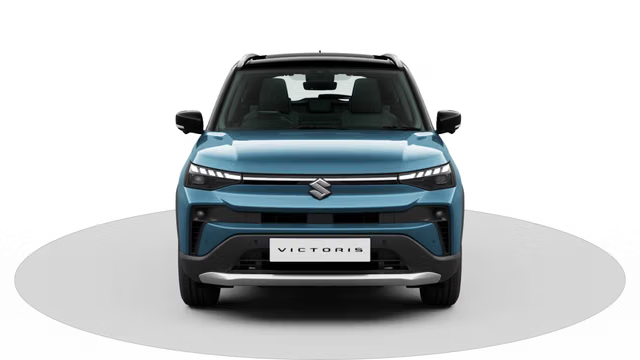 Importance of charging infrastructure to support upcoming Maruti EVs:
- The success of models such as the eVX depends on easy access to reliable charging points nationwide.
- Without widespread public charging, mass-market customers – Maruti’s core base – may hesitate to switch to EVs.
Alignment with India
- The Indian government has set a target of 46,000 public charging stations by 2030, while Maruti alone plans to install 1 lakh charging stations, a figure higher than national projections.
- Supports India’s target of 30 percent electric car penetration by 2030 under the e-Mobility Mission.
- Strengthens private-sector participation, which reduces pressure on government-funded infrastructure.
1 Lakh Charging Point Mission
Maruti Suzuki plan to set up 1 lakh EV charging points by 2030 marks one of the most extensive private-sector commitments in India’s EV ecosystem. This mission aims to create a reliable, expansive network of chargers across cities, towns, highways, workplaces, and residential areas. By combining multiple charger types, partnerships, and a customer-first approach, Maruti seeks to build an EV ecosystem capable of supporting millions of future EV users nationwide.
Total stations to be deployed: 1,00,000 by 2030
- Maruti Suzuki will set up 100,000 EV chargers within the next 6 years in a phased manner.
- The rollout will begin with top metros and expand to Tier-2, Tier-3, and rural locations.
- The network aims to cover every major commute route, including daily city use and long-distance travel.
- This scale is larger than that of many existing networks combined, making it one of India’s most significant private EV infrastructure projects.
- The target includes both public charging stations and semi-public chargers installed at commercial hubs.
Mix of AC chargers
- AC slow chargers (3.3kW–7.4kW): Ideal for home parking, apartment complexes, offices, and long-hour parking zones.
- DC fast chargers (15kW–50kW): Designed for malls, fuel stations, dealerships, and public hubs for quick top-ups.
- Ultra-fast chargers (100kW+): For future long-range Maruti EVs and national highways.
- Community charging points for gated societies, RWAs, and commercial buildings to enable shared access.
- Chargers will be integrated with a unified app for booking, tracking, payments, and availability.
Focus on affordability
- Emphasis on 24/7 uptime, maintenance support, and reliable power supply.
- Designed to make EV ownership easy and accessible to the regular Indian family.
Partnership with CPOs, DISCOMs, malls, tech parks, and highways.
- Collaborations with Charge Point Operators (CPOs) for deployment, software, maintenance, and backend support.
- Installation at malls, multiplexes, office tech parks, and significant retail locations to maximize utilization.
Timeline: Year-by-Year Rollout Plan
This expansion of Maruti Suzuki’s charging network will take place in a structured, Indian EV adoption by the end of 2030, the target is full coverage nationwide, with 1 lakh operational chargers supporting millions of end users.
2024–25: Pilot phase, 5,000–8,000 chargers
- Initial deployment in Delhi, Mumbai, Bengaluru, Chennai, Pune, and Hyderabad—India’s top EV-ready markets.
- Emphasis should be placed on charger reliability, uptime, user experience, and app integration.
- Installation at Maruti dealerships, malls, tech parks and office zones.
- Early deployment of AC and moderate DC chargers to capture real-world usage data.
Improvements based on feedback before scaling nationwide.
- 2026–27: Expansion into Tier-2 & Tier-3 cities; 25,000–30,000 chargers (Bullets)
- Coverage extended to Lucknow, Jaipur, Patna, Indore, Kochi, Surat, Nagpur, and more growing urban centres.
- Emphasis on charging in residential societies, commercial hubs of small towns, and workplaces.
More DC fast chargers will be installed to support in-state, intercity travel.
- Deeper penetration into North-East, Central India, and coastal regions.
- Collaboration with state governments to speed up permits and subsidized electricity tariffs.
- 2028–29: National highway fast-charging network; more than 70,000 cumulative chargers (Bullets)
- Setting up of highway fast-charging corridors along the Golden Quadrilateral, NH44-North–South, and NH27-East–West.
- Installation of 50kW–150kW fast chargers along highways for long-distance EV travel.
- Strategically place every 40–60 km to eliminate range anxiety on cross-country trips.
Partnerships.
- Network expected to break the 70,000 charger barrier by the end of 2029 across Public and Semi-Public locations.
- 2030: Mission completion with 1 lakh chargers across India (Bullets)
- Completion of the 100,000-charger milestone, including urban, semi-urban, rural, and national highways.
- Full integration of all the chargers into a unified digital platform for payments, scheduling, and real-time tracking.
- Nationwide availability ensures EVs are as convenient to charge as today’s petrol/diesel vehicles.
- Infrastructure capable of supporting upcoming high-range Maruti EVs and India’s broader EV ecosystem.
- Substantial contribution towards the clean mobility targets of India in 2030 through a reduction in the emission burden and increasing the preparedness for electric vehicles.
Geographical Coverage
Maruti Suzuki’s EV charging network is designed to be truly nationwide, ensuring charging is not confined to big cities. Beyond this, Maruti’s extensive dealership and service network will also help extend coverage to thousands of localities across India.
Metro cities:
- Dense network of AC and DC fast chargers in top EV adoption hubs.
- Placement at malls, corporate parks, metro stations, and premium residential complexes.
- High-traffic zones like Connaught Place, Bandra, Koramangala, Anna Nagar, Jubilee Hills, and Kalyani Nagar are to get early coverage.
- Large clusters designed to support daily commuters and office-goers.
- Integration with public transport hubs for multi-modal connectivity.
Highways:
- Fast-charging points every 40–60 km for uninterrupted long-distance travel.
- Coverage over Delhi–Mumbai, Mumbai–Chennai, Chennai–Kolkata and Kolkata–Delhi routes.
- Dedicated highway hubs: 50 kW–150 kW chargers for quick top-ups.
- Partnerships with fuel stations, dhabas, hotels, and logistics hubs.
- Seamless travel on NH44, NH27, NH48, and other major highway networks.
Rural/semi-urban coverage
- Deployment in smaller towns where Maruti already has intense market penetration.
- Focus on district headquarters, rural markets, local transport hubs, and mandis.
- Affordable AC chargers are placed in locations with long parking hours.
- Facilitates early EV adoption by commercial users such as taxis and delivery fleets.
- Ensures that EV accessibility does not become constrained to rich or urban segments.
Charging infra support at Maruti dealerships and service centers:
- More than 3,000+ dealerships and service centers to serve as charging access points.
- On-site DC fast chargers for customers during service or test drives.
- Dedicated EV bays for quick charging, diagnostics, and maintenance.
- Residential charger installation assistance is available through the dealerships.
- Enables consistent coverage even in remote or less-developed areas.
Types of Chargers Being Installed
The Maruti Suzuki will comprise a wide array of chargers catering to different user requirements, from highway charging. This multi-tier charging architecture ensures that EV owners have access to convenient, flexible, and reliable charging irrespective of where they live, work, or travel.
AC 3.3kW/7.4kW wall boxes for homes & residential complexes
- Ideal for overnight charging, offering 6–10 hours of full charge depending on EV battery size.
- Ideal for apartment complexes, gated societies, offices, and personal parking spaces.
- Low installation cost makes it viable for middle-class households.
- Energy-efficient and easier on the local grid compared to fast chargers.
DC fast chargers for commercial
- Suitable for public parking lots, malls, tech parks, dealerships, and fuel stations.
- Equipped with multiple connectors, including CCS2, ensuring universal compatibility.
Ultra-fast chargers (100kW+) for future high-range EVs
- Targeted for highway corridors and major intercity routes.
- Capable of delivering 20% to 80% charge in 20–30 minutes for future long-range EVs.
- Essential for future Maruti EVs built on newborn electric platforms.
- Helps create genuine long-distance electric vehicle mobility in the country.
- Installed at large hubs having strong grid capacity and energy backup.
Smart-grid enabled, UPI-enabled & app-integrated devices
- All chargers would have UPI for payments, credit/debit cards, wallet options, and subscription plans.
- Integration with Maruti’s EV app to provide real-time charger availability, booking, and navigation.
- Smart-grid capabilities enable active load management to reduce electricity demand peaks.
- With remote monitoring, high uptimes are assured, and error resolution is quick.
- Future-ready for features like V2G and renewable energy optimization.
Technology & User Experience
Maruti Suzuki intends to provide not just an extensive but, more importantly, intuitive, user-friendly charging ecosystem. A single digital interface will facilitate easy charger location, slot reservation, payment, and charging status tracking for EV owners. Maruti aims to offer a seamless charging experience through smart connectivity and real-time data, including future-ready features such as V2G, thereby aligning with global standards that support long-term EV adoption in the country.
Unified app for charging locator, slot booking, and making payments.
- A single mobile application will enable users to identify nearby chargers, check their availability, and route to them.
- Customers can prebook charging slots on-site, reducing wait times, especially during peak hours.
- Integrated payment options such as UPI, cards, net banking, and e-wallets.
- The application displays charging speed, tariff details, and estimated charging time to support better planning.
- Allows checking of the charging progress remotely while customers are shopping, working, or relaxing.
Real-time availability and dynamic pricing
- Live updates on charger availability ensure users do not drive to unavailable points.
- Dynamic pricing would adjust for time of day, load, and demand, making charging more efficient.
- Users can view cheaper off-peak charging windows to save money.
- Helps balance grid load by shifting/rewarding charges during low-demand hours.
- Avoids congestion in high-footfall public spots.
Integration with navigation apps and Maruti EV dashboards:
- Chargers integrated directly with Google Maps, MapMyIndia, and in-car navigation systems.
- Maruti EV dashboards display information such as battery status, remaining range, and nearest compatible chargers.
- Real-time re-routing to an alternative charger if the chosen one is now occupied or offline.
- Trip planners help drivers calculate range, charging stops, and energy consumption.
- Improves long-distance EV travel convenience and predictability.
Vehicle-to-grid (V2G) and renewable energy sourcing in later phases
- The future-ready chargers will support V2G technology.
- Can effectively balance the load and bring in potential revenue for EV owners.
- Reduces carbon footprint and aligns with India’s sustainable mobility goals.
Investment & Partnerships
In infrastructure and technology, Maruti Suzuki will invest heavily over the next six years to achieve its ambitious target of 1 lakh EV charging points by 2030. This will be a multi-thousand-crore commitment supported by strong collaboration with leading charging operators, energy providers, DISCOMs, and infrastructure developers. Government policies, such as FAME-II, state EV policies, and Production-Linked Incentive schemes, have further accelerated deployment by reducing costs and streamlining the approval process.
An estimated multi-thousand crore investment over 6 years
- Expected range from ₹3,000–₹5,000+ crores, based on charger categories and grid upgrades.
- Significant spending on high-capacity DC fast chargers and large highway hubs.
- Budget allocated for software systems, app development, backend servers, and smart-grid integration.
- Additional investment in installation workforce, maintenance teams, and customer support infrastructure.
- Long-term operational costs are covered through subscription models, pay-per-use pricing, and partnerships.
Collaboration with charging companies, energy providers, and infrastructure firms
- Installation, O&M, and energy management systems with partnerships through Charge Point Operators.
- Tie-ups with battery technology firms to ensure compatibility for upcoming Maruti EVs.
- Coordinating with energy providers and DISCOMs for grid capacity planning and upgrading transformers.
- Collaborations with real estate groups, malls, tech parks, and hospitality chains for charger placements.
- Synergy with oil companies and highway infrastructure firms to build fast-charging corridors nationwide.
Support through government incentives and PLI schemes
- Utilizing state EV policies that include subsidies on installation cost and electricity tariff benefits.
- Alignment with the FAME-II norms that support the expansion of public charging infrastructure.
- Leverage of PLI schemes for batteries and advanced automotive technologies for a reduction in long-term costs.
- Faster approvals for land use and electrical connections.
Expected Impact on the EV Market
Maruti Suzuki’s pan-India charging expansion will go a long way in transforming the Indian EV landscape. By making charging both accessible and more economical, the move will instill confidence in ordinary buyers, particularly those in the budget and mid-segment categories who are Maruti’s core customer constituency. This move not only supports the company’s upcoming EV lineup but also accelerates India’s broader transition to clean mobility. Range anxiety will fall dramatically once there is a robust network of charging stations in cities, towns, and on highways, helping EVs become mainstream by 2030.
Boosts EV confidence
- Builds trust in EV ownership by minimizing uncertainty around charging availability.
- Encourages first-time buyers to switch from petrol/diesel to EVs.
- Helps middle-class families consider EVs as practical everyday vehicles.
Helping Maruti’s EV models reach mass-market penetration:
- A strong infrastructure backbone ensures a smoother adoption of upcoming EVs like the Maruti eVX.
- Charging support at dealerships and service centers improves customer convenience.
- Enables large-scale deployment of Maruti EVs beyond metros into Tier-2/3 regions.
- Supports fleet adoption: taxis, ride-hailing, and delivery vehicles will increase sales volumes.
Electrification of India’s mobility will be accelerated by 2030:
- Contributes heavily to the national targets of 30% electric car penetration by 2030.
- Strengthens India’s public charging density across urban and rural regions.
- This will create a ripple effect, encouraging private investments into EV infrastructure.
- Supports the government’s vision to reduce oil imports and transportation-related emissions.
- Makes electric vehicle adoption possible across a far broader socio-economic spectrum.
Potential nationwide reduction of range anxiety
- Dense high-speed charging along highways mitigates concerns about long-distance travel.
- An extensive network provides backup options for all EV users, improving reliability.
Challenges & Considerations
| Point | Detailed Explanation |
| Land availability & local permissions | Finding suitable, high-footfall locations in cities, highways, malls, fuel pumps, and rural areas requires coordination with state authorities, private landowners, and municipal bodies. Delays in permits can slow deployment. |
| Heavy grid load in peak charging zones | Metro cities and industrial belts already face high electricity demand. Adding fast chargers can strain grids, requiring load assessments, transformers, and, in some cases, renewable or battery storage backup. |
| Ensuring >95% uptime & consistent maintenance | A large network demands strong backend monitoring, rapid fault repair teams, reliable hardware suppliers, and predictive maintenance systems to prevent charger downtime. |
| Competition with major charging players | Established networks like Tata Power EZ Charge, Jio-BP Pulse, Statiq, Chargezone, and others already dominate key urban routes, pushing Maruti to differentiate with pricing, speed, and availability. |
Conclusion
Maruti Suzuki’s plan to deploy 1 lakh EV charging points by 2030 is undoubtedly one of the most ambitious infrastructure commitments in the Indian electric mobility ecosystem. Maruti Suzuki is set to make mass electric mobility truly mainstream by 2030.
FAQs
- How many charging points does Maruti Suzuki plan to install?
Maruti Suzuki has announced a mission of installing 1 lakh EV charging points across India by 2030.
- How will users find and access these chargers?
One unified mobile app will enable users to:
- Find nearby chargers
- check availability
- book time slots
- Pay bills online
- Track charging history
- When will this project be completed?
This mission will be completed by 2030, with phased rollouts each year.
- Are ultra-fast chargers included?
Yes. Maruti will deploy 100kW+ ultra-fast chargers at key highway and metro locations for future long-range EVs.
- Is Maruti working in collaboration with other companies on this project?
Yes. Maruti Suzuki will partner with charging companies, energy providers, and infrastructure firms, and will use government incentives/PLI schemes.
- How will this impact the EV market?
The rollout will:
- Boost consumer confidence
- Drive EV adoption into the mass market
- Reduce range anxiety
Accelerate India’s transition to clean mobility by 2030
- What are the challenges that Maruti could face?
The key challenges are land availability, local permissions, power load management, and intense competition from Tata Power, Jio-BP, Statiq, among others